
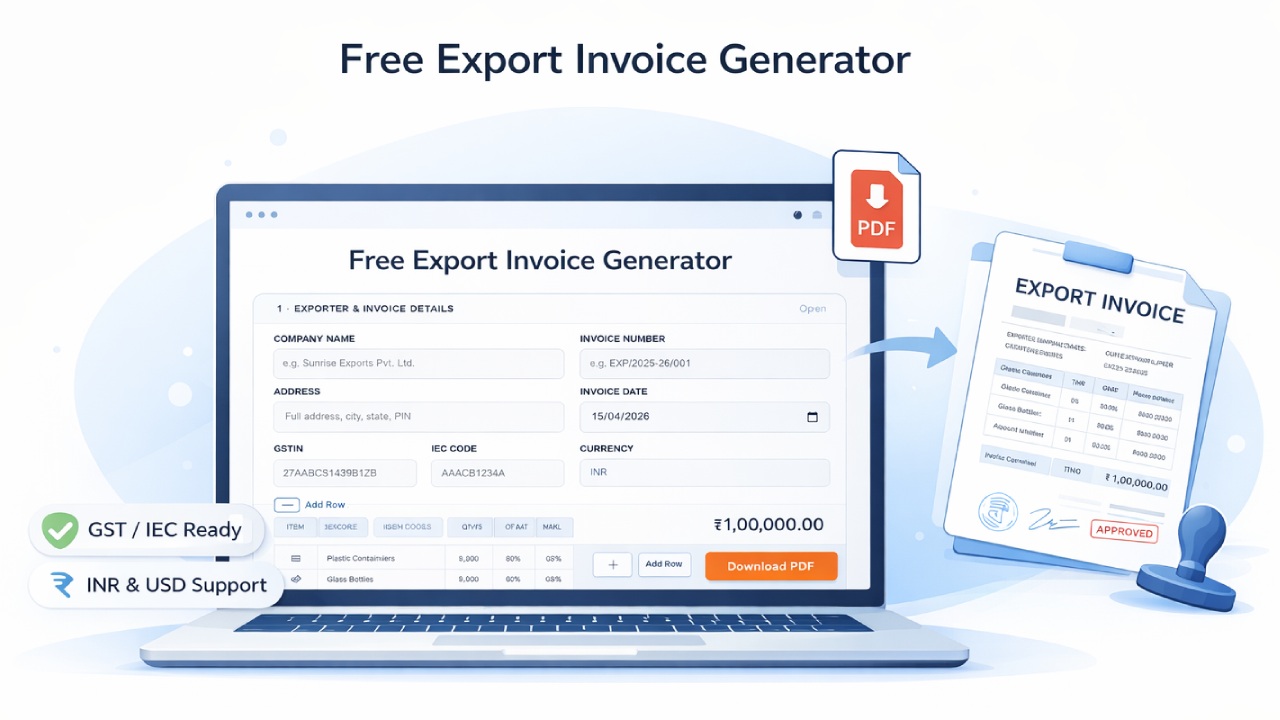
Free Export Invoice Generator
Fill the form below · All data saved locally · Download PDF
Stays on your device only
| # | Description of Goods | ITC-HS Code | Qty | Unit | Unit Price | Total |
|---|
| Subtotal | 0.00 |
| Freight | |
| Insurance | |
| Other Charges | |
| Grand Total | 0.00 |
Saved locally, appears in PDF
Fill Exporter Details
Enter your legal company name, address, GSTIN, and IEC Code. Upload your company logo – it is saved on your device and loads automatically next time.
Enter Buyer and Consignee Info
Enter the foreign buyer’s full name, address, and country. If goods are shipped to a warehouse or third-party, fill the Consignee field separately to match the shipping bill.
Set Shipment Details and Incoterms
Select your Port of Loading, Port of Discharge, and mode of transport. Choose the correct Incoterms (FOB, CIF, EXW etc.) – this determines legal liability between you and the buyer.
Add Line Items with HS Codes
Add each product with its 8-digit ITC-HS code, quantity, unit, and unit price. The tool auto-calculates row totals and the grand total. Add freight or insurance in Section 5 if applicable.
Add Declaration and Download PDF
Tick the LUT / Bond declaration in Section 7 if you are exporting without IGST. Add your authorised signatory name and upload a signature image. Click Download PDF for a print-ready A4 invoice.
Using the Wrong 8-Digit HS Code
Using a generic 4 or 6-digit code instead of the specific 8-digit ITC-HS classification is the most frequent reason for Yellow Channel inspections. An incorrect code can delay clearance by 4-10 days and trigger reassessment of export benefits like RoDTEP.
Mismatch Between Invoice and Packing List
Customs officers cross-verify every detail. A mismatch in Net Weight, Gross Weight, or Package Count between the Commercial Invoice and the Packing List is a major red flag that often leads to mandatory physical examinations.
Expired or Missing LUT (RFD-11)
Your Letter of Undertaking (LUT) is valid for one financial year only. Using a previous year’s LUT in April is a common mistake. If your LUT is expired, you must pay IGST on the invoice and claim a refund later – blocking your working capital.
Vague Product Descriptions
Generic descriptions like “Garments” or “Machine Parts” are no longer sufficient. Customs requires a clear description including material composition and intended use to match the declared HS code accurately.
Unregistered AD Code at the Port
Your Authorized Dealer (AD) Code must be manually registered on ICEGATE for your specific port of export. Without this, your Shipping Bill cannot be generated – even if your invoice is perfect.
Commercial Invoice (this tool)
The primary legal document for customs valuation, duty assessment, and bank payment processing. Every other document is verified against this invoice – all values, weights, and descriptions must match exactly.
Packing List
Describes the physical details of your shipment – number of boxes, package type, individual and total weights, dimensions, and shipping marks. Every figure must match your export invoice exactly.
Shipping Bill
The main document filed on the ICEGATE portal with Indian Customs. Without a Let Export Order (LEO) on the Shipping Bill, goods cannot leave India.
Bill of Lading (BL) or Airway Bill (AWB)
Your contract of carriage issued by the shipping line or airline. The BL is also the document of title for sea shipments – the buyer needs it to collect goods at the destination port.
Certificate of Origin
Required by some importing countries to confirm goods are Made in India – enabling your buyer to claim preferential duty rates under FTAs (India-UAE, India-ASEAN, GSP schemes).
What is Zero-Rated Supply?
Under Indian GST law, all exports are “Zero-Rated.” This means you do not charge GST to your international buyer. However, you still need to report the transaction correctly and include your GSTIN on the invoice for compliance.
Exporting Under LUT – The Right Way
Most exporters use a Letter of Undertaking (LUT) filed via Form GST RFD-11 on the GST portal. This allows you to export without paying IGST upfront – avoiding the need to block working capital and wait for refunds. Our tool includes the standard LUT declaration in Section 7.
Exporting With IGST Payment
If you do not have an active LUT, you must pay IGST on the export invoice and then apply for a refund. The refund process works but takes time – which is why most established exporters maintain an active LUT at all times.
An export invoice – also called a commercial invoice – is the legal document issued by an Indian exporter to a foreign buyer. It serves as proof of sale, the basis for customs duty assessment in the importing country, and the primary document for receiving foreign currency payments through your bank.
Under Indian law, every goods export must be accompanied by a compliant commercial invoice. Customs officials in both India and the destination country use this document to verify the shipment, classify goods, and calculate applicable duties. Your bank requires it to process inward remittances and issue the FIRC (Foreign Inward Remittance Certificate) needed for GST refunds.
A compliant Indian export invoice must include: exporter name and address with GSTIN and IEC, buyer details, a unique sequential invoice number, invoice date, currency, 8-digit ITC-HS codes for all goods, unit prices and total value, Incoterms, shipment details, bank details for payment, and the LUT or IGST declaration.