
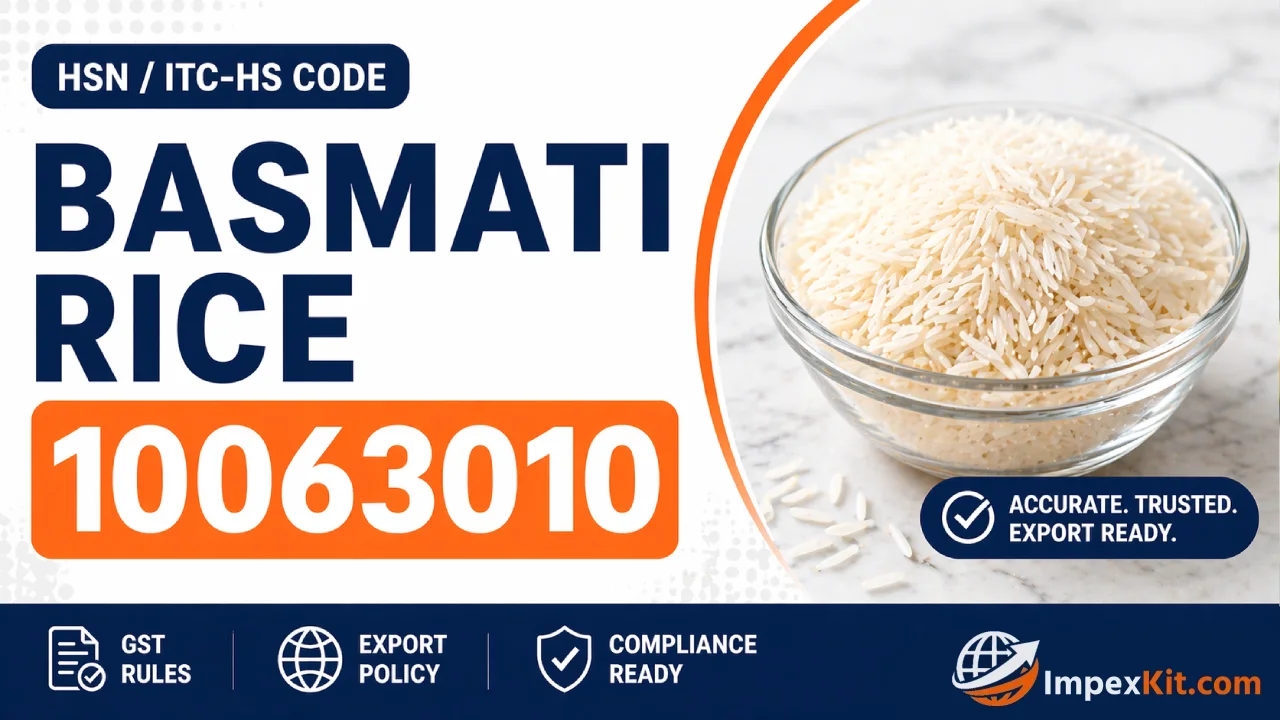
- HSN Code: 10063010
- GST Rate: 5% (Branded) | 0% (Unbranded)
- Export Policy: Free (Subject to MEP & APEDA)
- Chapter: 10 – Cereals
India is the world’s largest exporter of basmati rice, with exports worth billions of dollars annually to markets in the Middle East, Europe, North America, and Australia. Whether you are a rice exporter, miller, or trader, using the correct HSN code is essential for GST invoicing, shipping bills, and export documentation.
This guide covers HSN code 10063010 – the correct classification for basmati rice – along with GST rate, export policy, and RoDTEP applicability.
What Is Basmati Rice?
Basmati is a long-grain, aromatic rice variety grown predominantly in the Indo-Gangetic plains of India – including Punjab, Haryana, Uttar Pradesh, Uttarakhand, Himachal Pradesh, Delhi, and Jammu & Kashmir. It is known for its distinctive fragrance, elongated grain, and non-sticky texture after cooking.
Popular basmati varieties exported from India include 1121 Basmati, 1509 Basmati, Pusa Basmati 1, Taraori Basmati (HBC-19), Dehraduni Basmati, and Sharbati Basmati. Each variety differs in grain length, aroma, and price point – but all use the same HSN code for trade and GST purposes.
Popular Basmati Varieties and Export Grades
India exports several premium varieties under HSN 10063010, including the extra-long-grain 1121 Basmati, the aromatic 1509, and traditional favorites like Pusa Basmati 1 and Taraori. Beyond the variety, exporters must also categorize rice by its processing grade-such as Raw, Steam, Sella (Parboiled), or Golden Sella.
While all these grades use the same 8-digit ITC-HS code, the specific variety and grade (e.g., 1121 Sella Rice) must be clearly declared on your Export Invoice to comply with APEDA standards and Minimum Export Price (MEP) regulations.
HSN Code for Basmati Rice – 10063010
The correct HSN code for basmati rice is 10063010.
| Level | Code | Description |
|---|---|---|
| Chapter | 10 | Cereals |
| Heading | 1006 | Rice |
| Sub-heading | 100630 | Semi-milled or wholly milled rice, whether or not polished or glazed |
| 8-digit | 10063010 | Basmati rice (milled/semi-milled) |
Expert Tip (Avadhut Taru): Don’t confuse Basmati (10063010) with Long Grain Non-Basmati (10063091). Even if the grain looks long, if it doesn’t meet the “Aroma” and “Grown Area” standards of APEDA, customs will reject the Basmati classification. Always verify your variety before finalizing your Export Invoice.
Pro-Tip on Rice Grades: When preparing your Export Invoice, clearly mention the grade – Steam, Raw, or Sella. While the HSN code (10063010) is the same, Customs and APEDA use the grade description to verify the price against the Minimum Export Price (MEP).
Quick breakdown:
- 10 → Chapter: Cereals
- 1006 → Heading: Rice (all types)
- 100630 → Sub-heading: Semi-milled or wholly milled rice
- 10063010 → Full 8-digit code specifically for basmati rice
Use 10063010 on all GST tax invoices, e-way bills, shipping bills, and commercial export invoices for basmati rice in milled or semi-milled form.
Important: Brown basmati rice (husked/cargo rice, not fully milled) falls under a different sub-heading – 100620. And basmati paddy (unhusked, straight from the field) falls under 100610. Confirm the processing stage of your product before using 10063010.
GST Rate on Basmati Rice
GST rate: 5% (for packaged/branded basmati rice)
| Supply Type | GST Rate |
|---|---|
| Branded, packaged basmati rice | 5% |
| Unbranded / loose basmati rice | Nil (0%) |
| IGST on interstate supply (branded) | 5% |
| Export (all types) | Zero-rated |
The GST treatment depends on whether the rice is sold under a registered brand name in a sealed pack. Unbranded or loose rice remains exempt. This distinction is critical for rice millers and traders raising B2B invoices.
Basmati Rice (10063010) vs. Other Rice Categories
| Variety / Stage | HSN Code | Policy / Condition |
|---|---|---|
| Basmati Rice (Milled) | 10063010 | Free (Subject to MEP) |
| Brown Basmati Rice | 10062010 | Different Sub-heading |
| Non-Basmati White Rice | 10063090 | Often Restricted/ Prohibited |
For exports, GST is zero-rated regardless of branding. Most exporters file a Letter of Undertaking (LUT) to ship without paying IGST upfront, avoiding any refund delay. Learn more: What is LUT in GST – How to File Form RFD-11 Before March 31
Verify current rates on cbic-gst.gov.in before invoicing if you are unsure about branded vs unbranded treatment under GST 2.0.
Export Policy for Basmati Rice
Export Policy: FREE (with conditions)
Basmati rice export is classified as Free under Schedule II of India’s ITC-HS Export Policy – but with important regulatory conditions that exporters must follow:
- Minimum Export Price (MEP): The government periodically imposes or revises a Minimum Export Price for basmati rice. Always check the current MEP notification from DGFT before confirming export contracts.
- APEDA Registration: Basmati rice exporters must be registered with APEDA (Agricultural and Processed Food Products Export Development Authority). This is mandatory, not optional.
- Certificate of Origin / Authenticity: Many importing countries require an APEDA-issued Certificate of Origin for basmati rice to confirm Indian origin and authenticity.
- No IEC, No Export: A valid IEC (Importer Exporter Code) is the baseline requirement for any exporter. If you don’t have one yet, read: What is IEC Code – How to Apply for Import Export Code in India (2026)
Note: Non-basmati white rice export has faced periodic restrictions and MEP impositions that are separate from basmati policy. This article covers basmati rice (10063010) only.
RoDTEP and Duty Drawback for Basmati Rice
RoDTEP: Basmati rice under ITC-HS 10063010 is covered under the RoDTEP (Remission of Duties and Taxes on Exported Products) scheme. The exact rate is notified by DGFT and revised periodically. Check the current schedule at dgft.gov.in before filing your shipping bill.
Duty Drawback: Rice exporters using imported inputs – such as packaging materials, processing machinery parts, or specific additives – may be eligible for All Industry Rate (AIR) drawback. Consult your Customs House Agent (CHA) to confirm eligibility and the applicable schedule.
A correctly prepared export invoice is critical for RoDTEP and drawback claims – missing fields like IEC, GSTIN, LUT reference, or shipping bill number can delay or reject your claim. Use the Export Invoice Generator to create compliant, India-specific export invoices with all mandatory GST and customs fields built in.
Who Searches for HSN Code 10063010?
This article is useful for:
- Basmati rice exporters preparing commercial invoices and shipping bills for overseas buyers
- Rice millers and processors filing GSTR-1 and GSTR-3B for branded rice supply
- Commodity traders and brokers handling bulk basmati purchase and resale with B2B invoices
- Wholesalers and distributors supplying branded basmati to retailers across states
- CAs and tax consultants advising agri-commodity or food processing clients
Practical example: A rice milling unit in Karnal procures 1121 Basmati paddy, mills it to polished grade, packs it in 25 kg bags under a registered brand, and exports to a supermarket chain in Saudi Arabia. They file a shipping bill using ITC-HS 10063010, declare USD value, reference their APEDA registration and LUT number on the commercial invoice, and claim RoDTEP credit post-shipment via ICEGATE.
HSN Classification for Major Rice Brands
Whether you are a distributor or retailer for top Indian rice brands, the HSN code for branded, packaged Basmati remains 10063010 (attracting 5% GST). This applies to products from:
- Daawat (LT Foods)
- India Gate (KRBL Limited)
- Kohinoor (Adani Wilmar)
- Lal Qilla (Amar Singh Chawal Wala)
- Fortune Basmati Rice
Frequently Asked Questions
What is the HSN code for basmati rice?
The HSN code for basmati rice (milled) is 10063010. This 8-digit ITC-HS code is used on GST invoices, e-way bills, shipping bills, and all export documentation.
What is the GST rate on basmati rice?
Branded, packaged basmati rice attracts 5% GST. Unbranded or loose basmati rice is exempt (Nil GST). Exports are zero-rated under GST regardless of branding.
Is basmati rice export free or restricted in India?
Basmati rice is in the Free export category under Schedule II of India’s Foreign Trade Policy, but exporters must comply with APEDA registration requirements and any active Minimum Export Price (MEP) notifications from DGFT.
Do all basmati varieties like 1121, 1509, and Pusa Basmati use the same HSN code?
Yes. All milled basmati varieties – including 1121, 1509, Pusa Basmati 1, Dehraduni, Taraori, and Sharbati – use HSN code 10063010 for GST and export purposes. The variety name does not change the HSN classification.
Is APEDA registration mandatory for basmati rice export?
Yes. APEDA registration is mandatory for all basmati rice exporters in India. It is required for obtaining the Certificate of Origin and for accessing export promotion schemes. A valid IEC is also required as a baseline for export.
Basmati Rice ka Minimum Export Price (MEP) kya hai?
MEP woh minimum price hai jis par aapko rice export karna zaroori hai. Agar aapka contract price MEP se kam hai, toh aap export nahi kar payenge. Current MEP notifications ke liye hamesha DGFT website check karein.
Kya 1121 aur 1509 Basmati ka HSN code same hai?
Haan, sabhi basmati varieties (1121, 1509, Pusa) ke liye HSN code 10063010 hi use hota hai.
Basmati export ke liye APEDA registration zaroori hai?
Bilkul! Bina APEDA registration aur RCMC ke aap Basmati rice export nahi kar sakte. Ye Certificate of Origin ke liye bhi mandatory hai.

Avadhut Taru is the founder of ImpexKit, an engineer by background, and a researcher focused on simplifying import-export documentation and compliance for Indian businesses. Through detailed study of GST regulations, DGFT procedures, customs rules, and exporter compliance requirements, he creates practical tools and educational guides designed to make trade paperwork simpler, faster, and more accessible for Indian exporters.