
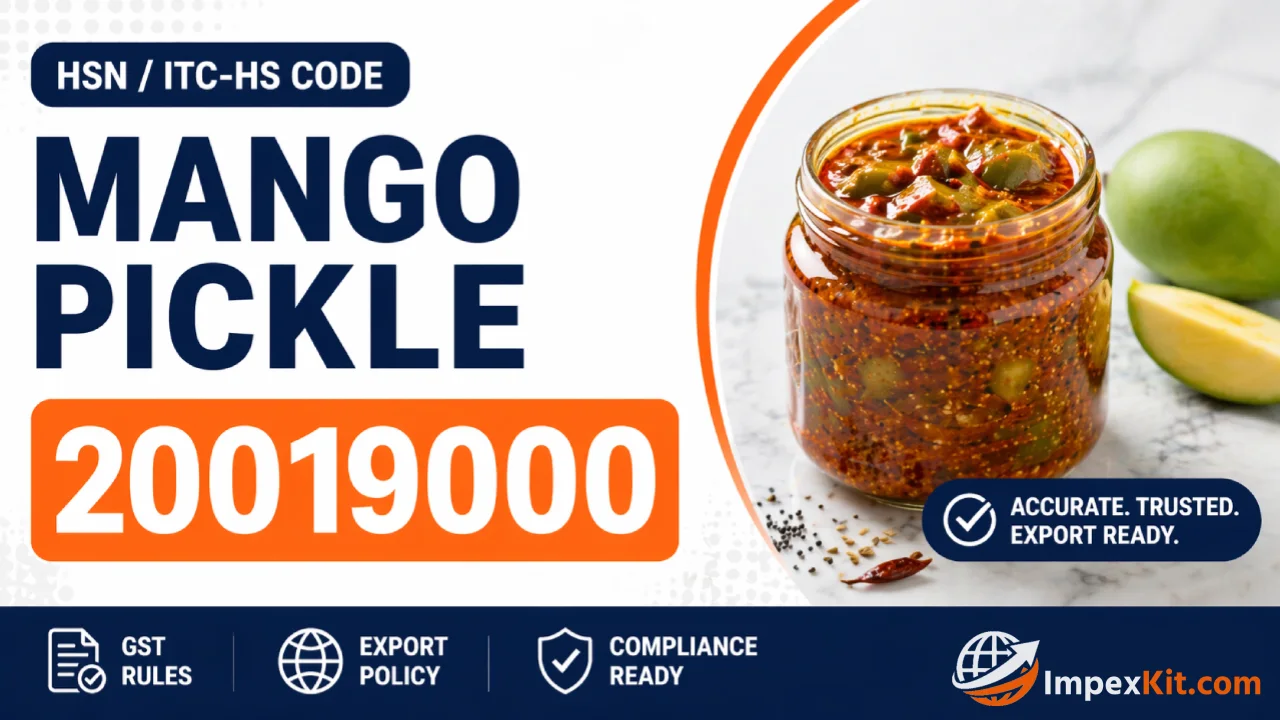
- HSN Code: 20019000
- GST Rate: 12%
- Export Policy: Free (No License Required)
- Chapter: 20 – Preparations of vegetables, fruit, nuts or other plant parts.
Mango pickle (aam ka achar) is India’s most exported pickle variety, with strong demand in the Middle East, UK, USA, Canada, and across the Indian diaspora. Whether you manufacture, process, or trade mango pickle, using the correct HSN code is mandatory for GST invoicing, e-way bills, and export documentation.
This guide covers the correct HSN code, GST rate, export policy, and RoDTEP status – everything you need in one place.
What Is Mango Pickle?
Mango pickle is a preserved food product made from raw mango pieces prepared in oil, salt, vinegar, or brine, mixed with spices. It is classified as a prepared or preserved vegetable product under international trade nomenclature.
It is sold in retail packs, bulk jars, and institutional packs for domestic and export markets.
HSN Code for Mango Pickle – 20019000
The correct HSN code for mango pickle is 20019000.
| Level | Code | Description |
|---|---|---|
| Chapter | 20 | Preparations of vegetables, fruit, nuts or other plant parts |
| Heading | 2001 | Vegetables, fruit prepared or preserved by vinegar or acetic acid |
| Sub-heading | 200190 | Other (vegetables/fruit preserved by vinegar or acetic acid – not cucumber/gherkin) |
| 8-digit | 20019000 | Mango pickle and similar vinegar/acetic acid preserved preparations |
⭐ Expert Tip (Avadhut Taru): In international trade, the preservative is key. If your pickle uses vinegar/acetic acid, use 20019000. If it’s a traditional Indian oil-based pickle without vinegar, it usually falls under HSN 20059900. Check your ingredients before finalizing your Export Invoice!
Quick breakdown:
- 20 → Chapter: Prepared vegetable and fruit products
- 2001 → Heading: Preserved using vinegar or acetic acid
- 200190 → Sub-heading: Other preserved items (not cucumber/gherkin)
- 20019000 → Full 8-digit code covering mango pickle
Use 20019000 on all GST tax invoices, e-way bills, shipping bills, and export invoices.
Note: If your mango pickle is prepared in oil (not vinegar or acetic acid), the applicable code may differ – typically falling under 2005 (other vegetables prepared or preserved other than by vinegar). Confirm your preparation method before using this code. If unsure, verify on cbic-gst.gov.in or consult your CHA.
GST Rate on Mango Pickle
GST rate: 12%
| Tax Component | Rate |
|---|---|
| CGST | 6% |
| SGST | 6% |
| IGST (interstate / export) | 12% |
Mango pickle sold in sealed, branded retail packs attracts 12% GST. Loose or unbranded pickle sold in bulk may attract a different rate – verify current treatment on cbic-gst.gov.in before invoicing.
Why Mango Pickle (2001) is different from Raw Salted Mango (0804)
| Feature | Mango Pickle | Salted/Brined Mango |
|---|---|---|
| Stage | Finished Product | Raw Material |
| Preservative | Oil, Spices, Vinegar | Salt or Brine only |
| HSN Code | 20019000 | 08045030 |
For exports, IGST is zero-rated. Exporters either pay IGST and claim a refund, or file a Letter of Undertaking (LUT) to export without paying IGST upfront. The LUT route is preferred by most regular exporters.
To understand how LUT works and how to file it, read: What is LUT in GST – How to File Form RFD-11 Before March 31
Export Policy for Mango Pickle
Export Policy: FREE
Mango pickle is classified under the Free export category as per Schedule II of India’s ITC-HS Export Policy. This means:
- No export licence required
- No quantity restriction
- No prior approval from DGFT or any ministry
- Only a valid IEC (Importer Exporter Code) is needed to begin exporting
If you are a pickle manufacturer planning to export for the first time, getting an IEC is your first step. Read: What is IEC Code – How to Apply for Import Export Code in India (2026)
Mandatory Compliance: FSSAI & APEDA for Pickle Export
Mango pickle is a food product, so customs and international buyers require specific certifications:
- FSSAI License: You must have a “Central License” from FSSAI as an Exporter. A basic state registration is not enough for international trade.
- APEDA RCMC: Since pickles fall under processed foods, registering with APEDA is mandatory to obtain the RCMC (Registration Cum Membership Certificate). This is required to claim RoDTEP benefits and to issue the “Certificate of Origin” for your buyers in the UAE or USA.
RoDTEP and Duty Drawback for Mango Pickle
RoDTEP: Mango pickle under HSN 20019000 is covered under India’s RoDTEP (Remission of Duties and Taxes on Exported Products) scheme. The exact rate is notified by DGFT and revised periodically. Check the current RoDTEP schedule at dgft.gov.in for the rate applicable to ITC-HS 20019000.
Duty Drawback: If you import any raw material or packaging used in manufacturing (such as speciality spices, glass jars, or specific additives), you may be eligible for All Industry Rate (AIR) drawback. Consult your Customs House Agent (CHA) for the applicable drawback schedule.
To ensure your RoDTEP and drawback claims are not rejected, your export invoice must include all mandatory fields correctly – IEC, GSTIN, LUT or bond reference, and shipping bill details. Use the Export Invoice Generator to create fully compliant export invoices with all GST and customs fields pre-built.
Who Searches for HSN Code 20019000?
This topic is relevant for:
- Pickle and food processors filing monthly GST returns (GSTR-1, GSTR-3B)
- Small and MSME exporters preparing shipping bills and commercial invoices
- Kirana and wholesale traders raising B2B invoices for branded pickle stock
- Food brand owners exporting private-label pickle under their own brand
- Chartered accountants advising food sector clients on correct HSN classification
Practical example: A food processing unit in Rajasthan exports 200 cartons of mango pickle in glass jars to a distributor in the UAE. They file a shipping bill using ITC-HS code 20019000, declare the export value in USD, reference their LUT number on the commercial invoice, and claim RoDTEP credit post-shipment via ICEGATE.
HSN Classification for Top Mango Pickle Brands
Whether you are a retailer, distributor, or exporter of major Indian brands, the HSN code for packaged mango pickle remains 20019000 (attracting 12% GST). This applies to the following popular brands found in both domestic and export markets:
- Mother’s Recipe (Desai Foods)
- Pravin / Suhana (Pravin Masalewale)
- Priya Pickles (Ushodaya Enterprises)
- Nilon’s (Nilon’s Enterprises)
- Pachranga (Pachranga Foods)
- Bedekar (V.P. Bedekar & Sons)
- Double Horse (Manjilas Food Tech)
Note: If these brands offer a “Low Oil” or “Vinegar-Free” version, customs may occasionally look at HSN 2005, but for 90% of retail exports, 20019000 is the industry standard.
Frequently Asked Questions
What is the HSN code for mango pickle?
The HSN code for mango pickle is 20019000. This 8-digit ITC-HS code is used for GST invoicing, e-way bills, shipping bills, and all export documentation.
What is the GST rate on mango pickle?
Mango pickle in sealed branded packs attracts 12% GST (6% CGST + 6% SGST, or 12% IGST for interstate supply). Exports are zero-rated under GST.
Is mango pickle export free or restricted?
Mango pickle is in the Free export category under India’s Foreign Trade Policy (Schedule II). No licence or permission is needed – only a valid IEC is required.
Which HSN code applies if my pickle is oil-based, not vinegar-based?
If your mango pickle is prepared in oil instead of vinegar or acetic acid, it may fall under HSN heading 2005 instead of 2001. Confirm your preparation method and verify the correct code on cbic-gst.gov.in or consult a CHA before invoicing.
Is mango pickle eligible for RoDTEP benefit?
Yes, mango pickle under HSN 20019000 is covered under the RoDTEP scheme. Check the current applicable rate on the DGFT website (dgft.gov.in) as rates are revised periodically.
Mango pickle ka HSN code aur GST rate kya hai?
Mango pickle ka HSN code 20019000 hai aur is par 12% GST lagta hai.
Kya aam ka achar export karne ke liye special license chahiye?
Nahi, ye “Free” category mein hai. Bas aapke paas valid IEC Code aur FSSAI hona chahiye.

Avadhut Taru is the founder of ImpexKit, an engineer by background, and a researcher focused on simplifying import-export documentation and compliance for Indian businesses. Through detailed study of GST regulations, DGFT procedures, customs rules, and exporter compliance requirements, he creates practical tools and educational guides designed to make trade paperwork simpler, faster, and more accessible for Indian exporters.