
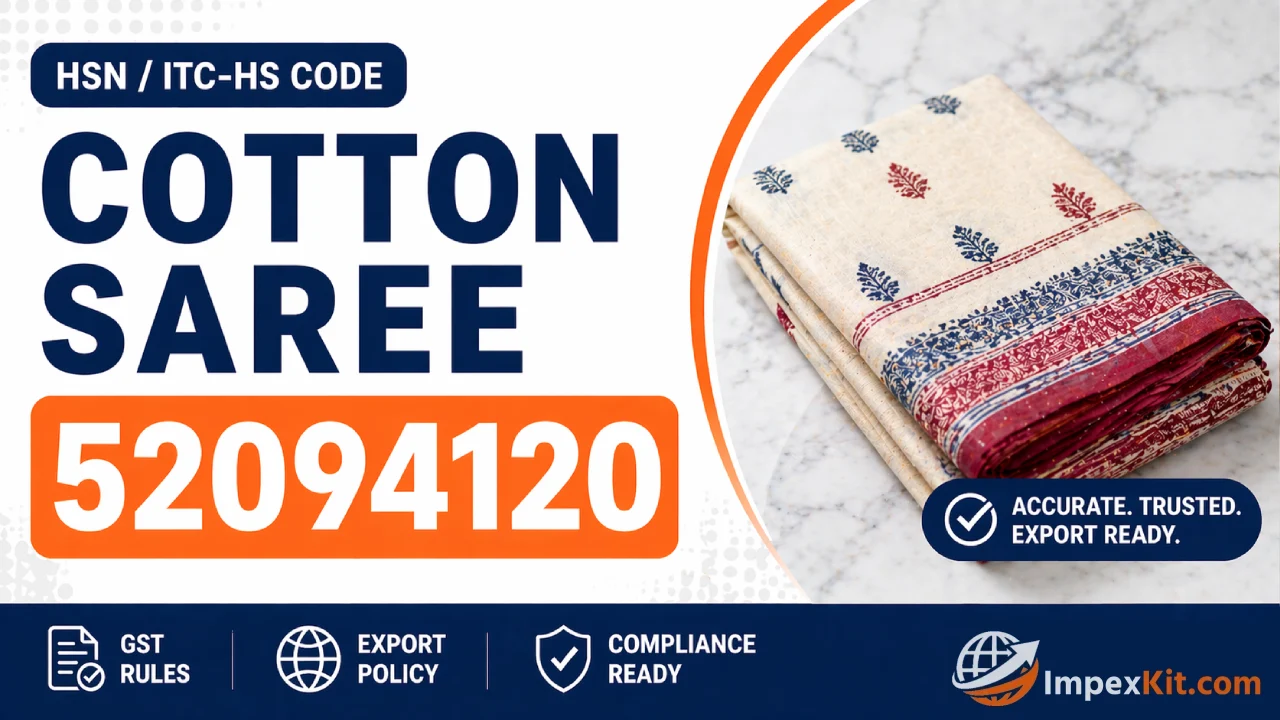
- Primary HSN Code: 52094120
- GST Rate: 5% (Value < ₹1000) | 12% (Value > ₹1000)
- Export Policy: Free (No License Required)
- Chapter: 52 – Cotton
- Key Condition: 85%+ cotton & >200 g/m²
Cotton sarees are one of India’s largest handloom segments, with strong domestic demand and growing export markets across the Middle East, Europe, the USA, and Southeast Asia. Whether you are a weaver, wholesaler, or exporter, using the correct HSN code on GST invoices, e-way bills, and shipping bills is mandatory – and for cotton sarees, getting it wrong is easier than it looks.
This guide covers HSN code 52094120, the correct GST rate, export policy, and the cotton vs silk saree classification difference – everything in one place.
Use HSN 52094120 only if your cotton saree exceeds 200 GSM and contains 85%+ cotton—otherwise a different chapter applies.
What Is a Cotton Saree?
A cotton saree is a traditional Indian garment woven from cotton yarn, sold as a continuous length of fabric – typically 5 to 9 metres – without cutting or stitching into a shaped garment. It is classified as a woven cotton fabric under India’s GST and customs tariff.
Major weaving centres include Dhaka-style cotton sarees from West Bengal, Chanderi from Madhya Pradesh, Sambalpuri from Odisha, Venkatagiri from Andhra Pradesh, Chettinad from Tamil Nadu, and Pochampally from Telangana. All use cotton as the primary fibre, though some include zari or polyester borders.
Popular Regional Cotton Sarees
India’s diverse weaving culture means that most regional specialties fall under Chapter 52. Whether you are exporting Sambalpuri (Odisha), Venkatagiri (Andhra), Chettinad (Tamil Nadu), or Khandua cotton sarees, the HSN code 52094120 remains the standard for dyed, plain-weave cotton fabrics exceeding 200 g/m². Mentioning the specific regional name on your shipping documents helps in better market positioning in the USA and Europe.
HSN Code for Cotton Saree – 52094120
The correct HSN code for cotton saree (woven, with more than 85% cotton by weight, weighing more than 200 g/m²) is 52094120.
| Level | Code | Description |
|---|---|---|
| Chapter | 52 | Cotton |
| Heading | 5209 | Woven fabrics of cotton, containing 85% or more by weight of cotton, weighing more than 200 g/m² |
| Sub-heading | 520941 | Plain weave – dyed |
| 8-digit | 52094120 | Sarees of cotton – dyed, plain weave, 85%+ cotton, over 200 g/m² |
Expert Tip (Avadhut Taru): HSN 52094120 only applies if the saree weighs more than 200 g/m². Many light-weight handloom cotton sarees (like Tant or fine Mulmul) weigh less than this and should be classified under Chapter 5208. Always check the GSM (Grams per Square Metre) of your fabric before generating your Export Invoice to avoid customs delays.
Quick breakdown:
- 52 → Chapter: Cotton
- 5209 → Heading: Woven cotton fabrics over 200 g/m² with 85%+ cotton content
- 520941 → Sub-heading: Plain weave, dyed
- 52094120 → Full 8-digit code for cotton sarees meeting these specifications
Important weight and composition check: HSN 52094120 applies when your cotton saree has 85% or more cotton content by weight and fabric weight exceeds 200 g/m². If your saree has significant zari, polyester, or silk content that brings cotton below 85%, or if the fabric weight is under 200 g/m², a different heading will apply. Verify your fabric specifications before using this code.
Cotton Saree vs Silk Saree – Which HSN Code Applies?
This is one of the most common classification errors in the handloom trade. Here is the simple rule:
| Saree Type | Primary Fibre | HSN Code | Chapter |
|---|---|---|---|
| Cotton saree | 85%+ cotton by weight | 52094120 | Chapter 52 |
| Silk saree | Predominantly silk | 50079020 | Chapter 50 |
| Cotton-silk blend saree | Mixed – neither dominant at 85%+ | Verify with CHA | Chapter 54 or 58 possible |
The chapter is determined by the primary fibre content by weight, not by the brand name or regional identity of the saree. A Chanderi saree, for example, may be pure cotton, pure silk, or a cotton-silk blend – each falls under a different HSN. Always confirm the fibre composition with your manufacturer or weaver before invoicing.
For a complete guide to finding the right 8-digit code for any textile product, read: ITC-HS Code: How to Find the Right 8-Digit Export Code in India (2026)
GST Rate on Cotton Saree
GST rate: 5% – for cotton sarees up to ₹1,000 per piece (MRP)
GST rate: 12% – for cotton sarees above ₹1,000 per piece (MRP)
| Saree MRP (per piece) | GST Rate | IGST (Interstate) |
|---|---|---|
| Up to ₹1,000 | 5% (2.5% CGST + 2.5% SGST) | 5% |
| Above ₹1,000 | 12% (6% CGST + 6% SGST) | 12% |
| Export (any value) | Zero-rated | Nil |
The ₹1,000 threshold is applied on a per-piece MRP basis, not per metre or per set. This applies uniformly across cotton sarees under Chapter 52. The same slab structure applies to silk sarees under Chapter 50 – the threshold is the same, only the chapter and HSN code differ.
For exports, IGST is zero-rated. File a Letter of Undertaking (LUT) before shipment to export without paying IGST upfront and avoid waiting for a refund. Read: What is LUT in GST – How to File Form RFD-11 Before March 31
Verify the current rate at cbic-gst.gov.in before invoicing if you are selling sarees near the ₹1,000 MRP threshold or dealing with mixed-fibre products.
Export Policy for Cotton Sarees
Export Policy: FREE
Cotton sarees are classified under the Free export category as per Schedule II of India’s ITC-HS Export Policy. This means:
- No export licence required
- No quantity or value restriction
- No prior DGFT approval needed
- A valid IEC (Importer Exporter Code) is the only mandatory baseline requirement to begin exporting
Handloom cotton sarees – including Sambalpuri, Pochampally, Venkatagiri, and Chettinad – may be eligible for additional support under the Handloom Export Promotion Council (HEPC) and the Office of the Development Commissioner for Handlooms. Weaver-exporters should explore these schemes for buyer access and exhibition participation.
If you are a weaver or first-time exporter, an IEC is your starting point. Read: What is IEC Code – How to Apply for Import Export Code in India (2026)
RoDTEP and Duty Drawback for Cotton Sarees
RoDTEP: Cotton sarees under ITC-HS 52094120 are covered under India’s RoDTEP (Remission of Duties and Taxes on Exported Products) scheme. The applicable rate is notified by DGFT and is subject to periodic revision. Check the current rate at dgft.gov.in before filing your shipping bill.
Duty Drawback: If you use imported inputs – such as speciality dyes, finishing chemicals, or imported yarns – in producing your cotton sarees, you may be eligible for All Industry Rate (AIR) drawback. Confirm with your Customs House Agent (CHA) before shipment.
Your export invoice must correctly state ITC-HS code 52094120, your IEC, GSTIN, LUT or bond reference, and the declared export value in foreign currency. Missing or wrong fields can delay RoDTEP credit and drawback claims. Use the Export Invoice Generator to produce a fully compliant, India-specific export invoice with all mandatory GST and customs fields pre-built.
Who Searches for HSN Code 52094120?
This article is relevant for:
- Handloom weavers in Odisha, Andhra Pradesh, Tamil Nadu, Telangana, and Madhya Pradesh filing monthly GST returns
- Textile exporters preparing commercial invoices and shipping bills for overseas buyers
- Saree wholesalers and distributors raising B2B invoices for bulk interstate supply
- Online sellers and boutique brands exporting cotton sarees to diaspora markets in the USA, UK, UAE, and Australia
- CAs and tax consultants resolving Chapter 52 classification queries for handloom clients
Practical example: A handloom cooperative in Odisha produces Sambalpuri cotton sarees, packs them in export-ready boxes, and fulfils an order from a South Asian grocery and clothing retailer in the UK. They file a shipping bill using ITC-HS code 52094120, declare the export value in GBP, reference their LUT on the commercial invoice to export without paying IGST, and claim RoDTEP credit post-shipment via ICEGATE.
Frequently Asked Questions
What is the HSN code for cotton saree?
The HSN code for cotton saree (plain weave, dyed, 85%+ cotton, over 200 g/m²) is 52094120. This 8-digit ITC-HS code is used for GST invoicing, e-way bills, shipping bills, and export documentation.
What is the GST rate on cotton saree?
Cotton sarees up to ₹1,000 per piece (MRP) attract 5% GST. Sarees above ₹1,000 per piece attract 12% GST. Exports are zero-rated under GST regardless of value.
What is the difference between HSN code for cotton saree and silk saree?
Cotton sarees fall under Chapter 52 (HSN 52094120) and silk sarees fall under Chapter 50 (HSN 50079020). The classification is based on the primary fibre content by weight – not the brand name or regional identity of the saree. Mixed-fibre sarees may fall under a different chapter entirely.
Is cotton saree export free or restricted in India?
Cotton sarees are in the Free export category under Schedule II of India’s Foreign Trade Policy. No export licence or DGFT approval is required – only a valid IEC code.
Does HSN 52094120 apply to all cotton sarees including Sambalpuri, Pochampally, and Chanderi?
It applies to cotton sarees that have 85% or more cotton content by weight and fabric weight over 200 g/m². Sambalpuri and Pochampally cotton sarees typically meet this specification. Chanderi sarees vary – pure cotton Chanderi uses Chapter 52, but silk or cotton-silk Chanderi may use a different code. Always confirm the fibre composition before invoicing.

Avadhut Taru is the founder of ImpexKit, an engineer by background, and a researcher focused on simplifying import-export documentation and compliance for Indian businesses. Through detailed study of GST regulations, DGFT procedures, customs rules, and exporter compliance requirements, he creates practical tools and educational guides designed to make trade paperwork simpler, faster, and more accessible for Indian exporters.