
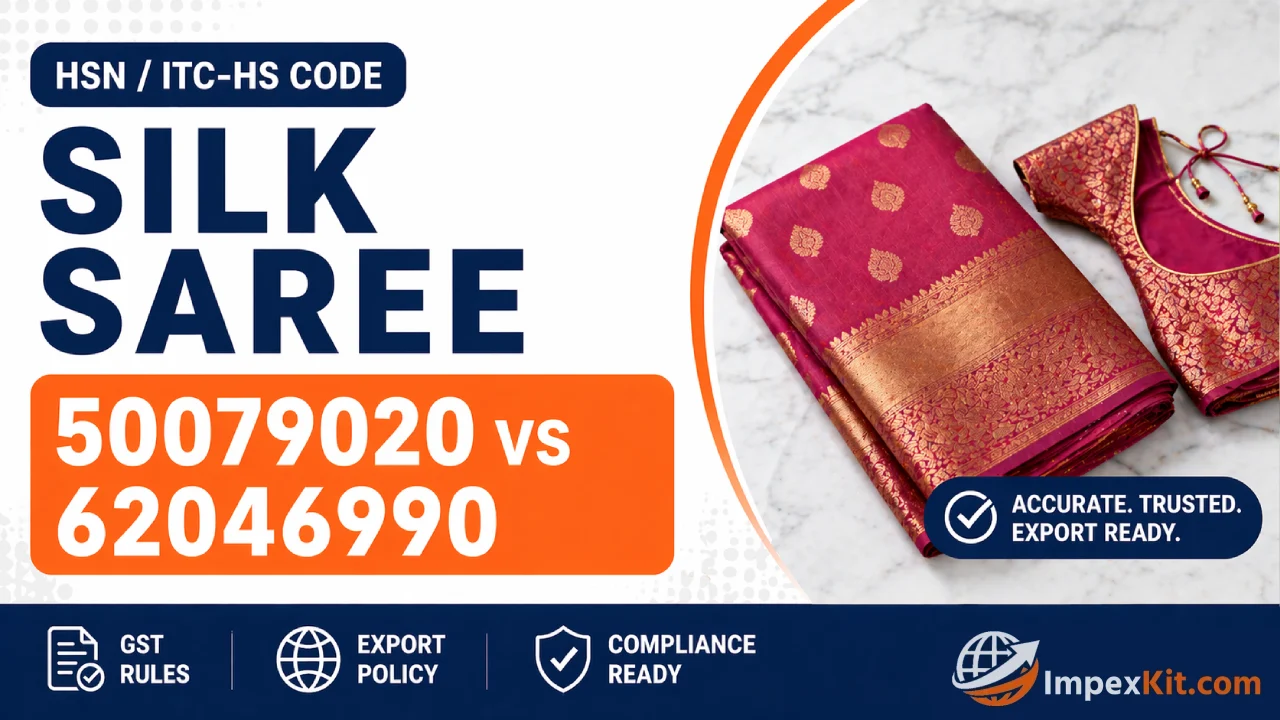
- Primary HSN Code: 50079020 (Silk Fabric/Saree)
- Secondary HSN Code: 62046990 (If sold with stitched blouse)
- GST Rate: 5% (Value < ₹1000) | 12% (Value > ₹1000)
- Export Policy: Free (No License Required)
Silk sarees are one of India’s most iconic handloom and textile exports – from Banarasi and Kanchipuram to Paithani and Mysore silk. But for GST invoicing and export documentation, silk sarees have a genuine classification problem: they can fall under Chapter 50 (silk fabrics) or Chapter 62 (made-up textile garments), depending on how the saree is presented and sold.
Using the wrong code leads to GST mismatches, shipping bill errors, and rejected export claims. This guide resolves the confusion clearly.
Confused between 50079020 and 62046990? Use Chapter 50 for unstitched sarees and Chapter 62 only when sold as a stitched garment set.
What Is a Silk Saree?
A silk saree is a traditional Indian garment made from silk yarn – woven in a single length of fabric, typically 5 to 9 metres, worn draped around the body. It is not cut or stitched into a shaped garment.
India exports silk sarees to markets across the USA, UK, UAE, Singapore, Canada, and Australia – both as ethnic wear and as luxury textile products. Major weaving centres include Varanasi (UP), Kanchipuram (Tamil Nadu), Dharmavaram (AP), Mysuru (Karnataka), and Paithani (Maharashtra).
Popular Export Varieties
India’s silk saree exports are driven by world-famous regional weaves. Whether you are exporting Banarasi Silk from UP, Kanchipuram from Tamil Nadu, Paithani from Maharashtra, or Mysore Silk from Karnataka, the HSN classification remains the same (50079020). Buyers in the USA, UK, and UAE often look for these specific names, so ensure your Export Invoice mentions the specific weave along with the HSN code.
HSN Code for Silk Saree – 50079020 vs 62046990
This is where most weavers and exporters get confused. Here is the clear rule:
| Classification | HSN Code | When to Use |
|---|---|---|
| Chapter 50 – Silk fabric / saree as fabric | 50079020 | Saree sold/exported as a length of woven silk fabric (unstitched, no blouse piece attached separately as garment) |
| Chapter 62 – Made-up garment / clothing article | 62046990 | Saree presented/classified as a women’s garment – typically when sold with stitched blouse or assessed as a clothing article by customs |
Expert Tip (Avadhut Taru): Customs classification depends on “presentation.” If the saree is unstitched (even with an unstitched blouse piece attached), use 50079020. If you provide a stitched blouse, the saree set may be classified under Chapter 62. Clearly declaring the “unstitched” nature on your Export Invoice can prevent unnecessary customs queries.
The practical rule: A saree is a length of fabric – not a cut-and-sewn garment. Under international trade classification (HS nomenclature), a saree is treated as woven fabric, not as a made-up garment, unless customs authorities classify it otherwise based on presentation.
In India’s domestic GST context, most silk sarees are correctly classified under Chapter 50. For export purposes, most Indian exporters and customs authorities use 50079020. However, if your saree is sold as part of a garment set with a stitched blouse, Chapter 62 may apply.
When in doubt, consult your Customs House Agent (CHA) or check the ITC-HS classification tool on DGFT’s website. Misclassification at the shipping bill stage can delay export clearance. A helpful guide to finding the right 8-digit code: ITC-HS Code: How to Find the Right 8-Digit Export Code in India (2026)
HSN Code Breakdown – 50079020
| Level | Code | Description |
|---|---|---|
| Chapter | 50 | Silk |
| Heading | 5007 | Woven fabrics of silk or silk waste |
| Sub-heading | 500790 | Other woven fabrics of silk |
| 8-digit | 50079020 | Sarees of silk (woven silk saree as fabric) |
HSN Code Breakdown – 62046990
| Level | Code | Description |
|---|---|---|
| Chapter | 62 | Articles of apparel and clothing accessories, not knitted or crocheted |
| Heading | 6204 | Women’s suits, ensembles, jackets, dresses, skirts, etc. |
| Sub-heading | 620469 | Dresses and other women’s garments of other textile materials |
| 8-digit | 62046990 | Other women’s garments of other fibres – used when saree is classified as a garment |
GST Rate on Silk Saree
GST rate: 5% – for silk sarees up to ₹1,000 per piece (MRP)
GST rate: 12% – for silk sarees above ₹1,000 per piece (MRP)
| Saree Value (MRP) | GST Rate | Chapter |
|---|---|---|
| Up to ₹1,000 per piece | 5% | 50 or 62 |
| Above ₹1,000 per piece | 12% | 50 or 62 |
| Export (any value) | Zero-rated | 50 or 62 |
This value-based GST slab applies across both Chapter 50 and Chapter 62 for silk sarees. The ₹1,000 threshold is based on the per-piece MRP, not per metre or per set. This was a key point clarified in GST Council decisions applicable post-2022 and remains in effect under GST 2.0.
For exports, IGST is zero-rated. File a Letter of Undertaking (LUT) before shipment to export without paying IGST upfront. This protects your working capital and avoids the refund wait. Read: What is LUT in GST – How to File Form RFD-11 Before March 31
Verify the current rate on cbic-gst.gov.in before invoicing if you are dealing with sarees near the ₹1,000 threshold.
Export Policy for Silk Sarees
Export Policy: FREE
Silk sarees are classified under the Free export category as per Schedule II of India’s ITC-HS Export Policy. This means:
- No export licence required
- No quantity or value restriction
- No prior DGFT approval needed
- A valid IEC (Importer Exporter Code) is the only mandatory baseline requirement
Handloom silk sarees – such as Banarasi, Kanchipuram, Paithani, and Mysore silk – may also be eligible for additional benefits under India’s Handloom Export Promotion Council (HEPC) schemes. Weaver-exporters should explore HEPC membership for buyer connections and trade fair participation.
If you are a weaver or small exporter setting up direct exports for the first time, getting an IEC is your first step: What is IEC Code – How to Apply for Import Export Code in India (2026)
Handloom Export Promotion Council (HEPC) Benefits
If you are exporting hand-woven silk sarees like Banarasi, Kanchipuram, or Paithani, joining the Handloom Export Promotion Council (HEPC) is highly recommended. As a nodal agency under the Ministry of Textiles, HEPC helps weaver-exporters in the following ways:
- RCMC Issuance: You need an RCMC (Registration Cum Membership Certificate) from HEPC to claim certain export incentives.
- Market Access Initiative (MAI): Get financial assistance to participate in international trade fairs and “Buyer-Seller Meets” in countries like the USA and UAE.
- Handloom Mark: HEPC promotes the use of the Handloom Mark and Silk Mark, which act as a guarantee of purity and quality for international buyers, allowing you to command a premium price.
RoDTEP and Duty Drawback for Silk Sarees
RoDTEP: Silk sarees under ITC-HS 50079020 are covered under the RoDTEP (Remission of Duties and Taxes on Exported Products) scheme. The applicable rate is notified by DGFT and revised periodically. Check the current schedule at dgft.gov.in for the rate applicable to your specific ITC-HS code.
Duty Drawback: If you use any imported inputs – such as imported silk yarn, dyes, or finishing chemicals – you may be eligible for All Industry Rate (AIR) drawback. Confirm the applicable schedule with your CHA before shipment.
Your export invoice must correctly state the ITC-HS code (50079020 or 62046990 – whichever applies), IEC, GSTIN, LUT reference, and declared export value in foreign currency. Use the Export Invoice Generator to prepare a fully compliant India-specific export invoice with all mandatory customs and GST fields.
Who Searches for HSN Code for Silk Saree?
This article is relevant for:
- Handloom weavers in Varanasi, Kanchipuram, Mysuru, and Dharmavaram filing GST returns
- Textile exporters preparing shipping bills and commercial invoices for overseas buyers
- Saree traders and wholesalers raising B2B invoices for inter-state bulk supply
- Boutique and designer brands exporting silk sarees to diaspora markets in the USA, UK, and UAE
- CAs and tax consultants resolving Chapter 50 vs Chapter 62 classification disputes for textile clients
Practical example: A weaving unit in Varanasi produces Banarasi pure silk sarees and receives an export order from a retailer in the UAE. They file a shipping bill using ITC-HS code 50079020, declare the export value in USD, reference their LUT number on the commercial invoice to export without IGST, and claim RoDTEP credit post-shipment through ICEGATE.
Frequently Asked Questions
What is the HSN code for silk saree?
The primary HSN code for silk saree (woven silk fabric) is 50079020. If classified as a women’s garment – typically when sold with a stitched blouse – the code 62046990 may apply. Most Indian exporters use 50079020 for saree exports.
What is the GST rate on silk saree?
Silk sarees priced up to ₹1,000 per piece attract 5% GST. Sarees priced above ₹1,000 per piece attract 12% GST. Exports are zero-rated under GST regardless of value.
Should I use Chapter 50 or Chapter 62 for a silk saree?
Use Chapter 50 (50079020) when the saree is sold as a length of woven fabric – which is the standard classification for most silk sarees. Use Chapter 62 (62046990) only if the saree is assessed as a made-up garment – typically when presented as a set with a stitched blouse. Consult your CHA if you are unsure.
Is silk saree export free or restricted in India?
Silk sarees are in the Free export category under Schedule II of India’s Foreign Trade Policy. No export licence or DGFT permission is required – only a valid IEC code.
Do Banarasi, Kanchipuram, and Mysore silk sarees all use the same HSN code?
Yes. All pure silk saree varieties – Banarasi, Kanchipuram, Paithani, Mysore silk, Dharmavaram – use HSN 50079020 for GST and export classification. The regional name or weave style does not change the HSN code.

Avadhut Taru is the founder of ImpexKit, an engineer by background, and a researcher focused on simplifying import-export documentation and compliance for Indian businesses. Through detailed study of GST regulations, DGFT procedures, customs rules, and exporter compliance requirements, he creates practical tools and educational guides designed to make trade paperwork simpler, faster, and more accessible for Indian exporters.