
If you have searched for an HS code for your export product, you have probably run into three different terms – ITC-HS Code, HSN Code, and HS Code – and wondered if they are the same thing, or if you are looking at the right list entirely.
Most exporters copy a code from a freight forwarder, a CA, or a Google result without understanding whether it is correct for their product, their context, or even their document. A wrong code on the shipping bill can delay your shipment at customs, disqualify you from RoDTEP or Duty Drawback benefits worth lakhs, and expose you to a show-cause notice going back years.
This guide solves the confusion end to end – what the code means, how it is structured, exactly where to find it, what to do when your product fits two codes, and what rides on getting it right.
| Key Details | Information |
|---|---|
| Official Portal | dgft.gov.in |
| Required Digits | 8 Digits (Mandatory for Exports) |
| Common Names | ITC-HS, HSN, or HS Code |
| Schedules | Schedule I (Import) & Schedule II (Export) |
| Key Risk | Wrong code = Loss of RoDTEP/Drawback |
| Revision Year | HS 2022 (Current) / HS 2027 (Upcoming) |
ITC-HS Code, HSN Code, HS Code – Why You See Three Names for the Same Thing
This is the first confusion every exporter hits. Here is the plain explanation:
HS Code (Harmonized System Code) is the international standard. It is a 6-digit code developed by the World Customs Organization (WCO) in 1988 and used by over 200 countries. The first 6 digits of any product’s code are identical worldwide. When your buyer in Germany or the USA refers to your product’s HS code, they mean these 6 digits.
HSN Code (Harmonized System of Nomenclature) is India’s term for the same system in the GST context. The GST portal, your GST invoice, and your GSTR-1 HSN summary all use this term. For domestic invoicing, GST turnover thresholds determine how many digits you need (4, 6, or 8). But the code itself is the same underlying system.
ITC-HS Code (Indian Trade Classification based on Harmonized System) is India’s 8-digit customs and DGFT version. The last 2 digits are India-specific – they carry the tariff item detail that the international 6-digit system does not have. This is the code that appears on your Shipping Bill, your export invoice, your DGFT applications, and your RoDTEP/Drawback claims.
| Term | Full Form | Digits | Where Used | Who Uses It |
|---|---|---|---|---|
| HS Code International |
Harmonized System Code | 6 digits | International trade documents; your buyer’s customs | WCO member countries (200+). Same worldwide for first 6 digits. |
| HSN Code GST Context |
Harmonized System of Nomenclature | 4 / 6 / 8 digits (depends on turnover) |
GST invoices, GSTR-1, GST portal search | Indian businesses for GST compliance. Same underlying system, GST-facing terminology. |
| ITC-HS Code Export / Customs |
Indian Trade Classification – Harmonized System | 8 digits always | Shipping Bill, DGFT portal, export invoice, RoDTEP, Drawback claims | Indian exporters and importers for all customs and DGFT purposes. |
For exporters, the rule is simple: always use the 8-digit ITC-HS code. Regardless of your GST turnover, the shipping bill and export invoice require 8 digits. Using 4 or 6 digits at customs will cause your filing to be rejected.
How an 8-Digit ITC-HS Code is Built – Reading the Structure
The 8-digit code is not a random number. It follows a strict hierarchy – each pair of digits narrows down the classification from a broad industry group to a very specific product type. Once you understand the structure, you can navigate the code list yourself.
Broad product family
Product category
International standard
India-specific
Here is how to read the structure using a real example – 62046990, which is a women’s garment of other textile materials:
- 62 → Chapter: Articles of apparel and clothing accessories, not knitted or crocheted
- 6204 → Heading: Women’s suits, ensembles, jackets, blazers, dresses, skirts, divided skirts, trousers, bib and brace overalls, breeches and shorts
- 620469 → Sub-heading: Of other textile materials (not wool, cotton, or man-made fibres)
- 62046990 → Tariff Item: The India-specific 8-digit classification for this specific type of women’s garment
The first 6 digits (620469) are the same in India, the EU, the USA, and Japan. The last 2 digits (90) are India-specific and may differ from what your buyer’s customs uses in their country.
Important: Never copy the last 2 digits from a foreign supplier or buyer’s invoice. Their country’s extension digits will be different. Always look up the Indian 8-digit code separately from the DGFT or ICEGATE portal.
Schedule I vs Schedule II – Exporters Must Look at the Right One
The ITC-HS classification is divided into two schedules. This is where many exporters look up the wrong list entirely:
- Schedule I – Covers import policy. It contains rules, restrictions, and conditions for goods being imported into India.
- Schedule II – Covers export policy. It tells you whether your product is freely exportable, restricted (requires a licence), or prohibited. This is the schedule exporters must check.
Both schedules use the same 8-digit ITC-HS codes, but the policy conditions attached to each code differ. A product may be freely importable under Schedule I and restricted for export under Schedule II – or vice versa.
When you check your product’s export status on the DGFT portal, the system automatically shows you the Schedule II (export) policy. But if you are looking at a printed or downloaded ITC-HS list from a third-party source, confirm it is the export schedule before relying on it.
The three export policy categories in Schedule II are:
- Free – No restriction. You can export without a licence or special permission.
- Restricted – Requires an export licence from DGFT before shipment.
- Prohibited – Cannot be exported from India under any circumstances.
How to Find Your ITC-HS Code – 3 Official Methods (Step by Step)
Method 1: DGFT Portal (Recommended for Exporters)
This is the primary official source for export-specific ITC-HS codes and policy conditions.
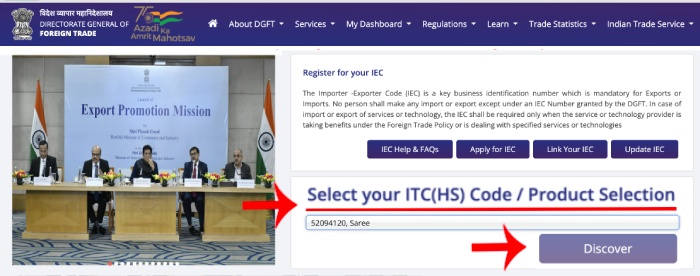
- Go to the official DGFT website: dgft.gov.in
- On the homepage, scroll slightly and find “Select your ITC(HS) Code / Product Selection”
- Enter your ITC(HS) Code or product name (e.g., 52081230 or Shirting Fabrics)
- Browse the results – matching 8-digit codes with descriptions will appear
- Select the most relevant code and click on “Discover”
- In the Discover panel, check export policy (Free / Restricted / Prohibited)
- Verify the product description carefully and note down the correct 8-digit code
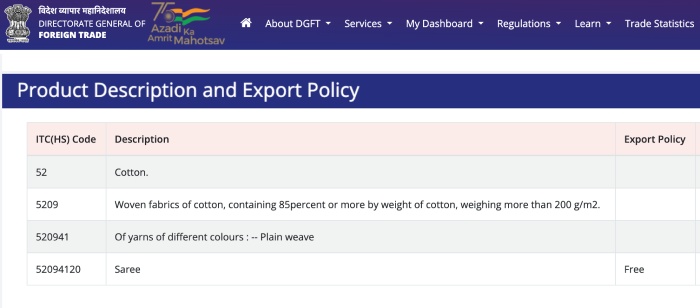
Tip: If a keyword search gives too many results, start with the chapter number. For example, if you know your product is a textile, try searching “Chapter 52” or “52” first to narrow down.
Method 2: GST Portal HSN Search (For Cross-Checking GST Rate)
The GST portal’s HSN search is useful for confirming the GST rate applicable to your product – which determines what you report in GSTR-1 Table 6A and what ITC (Input Tax Credit) you can claim on inputs.
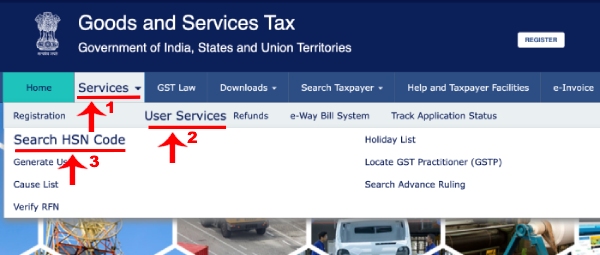
- Go to gst.gov.in – you do not need to log in
- Go to Services → User Services → Search HSN Code
- Enter your product description or the 4-digit chapter-heading
- The result shows the HSN code and the applicable GST rate
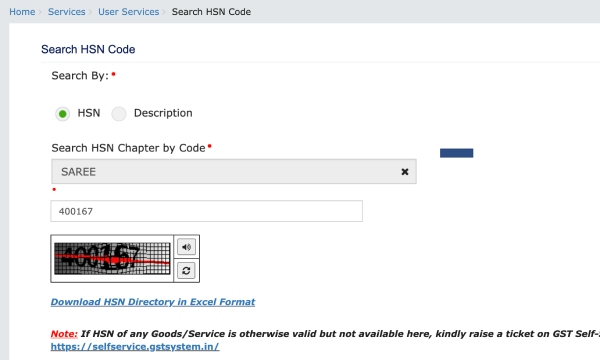
Use this to confirm your code’s GST rate. The 8-digit code you found on DGFT and the GST portal code should match for the first 6 digits. If they do not, you may have found different sub-headings – review both carefully.
Method 3: Indian Trade Portal (For RoDTEP and Incentive Rates)
The Indian Trade Portal (indiantradeportal.in) is the best place to check what export incentive rates – RoDTEP, Duty Drawback – are linked to your ITC-HS code.
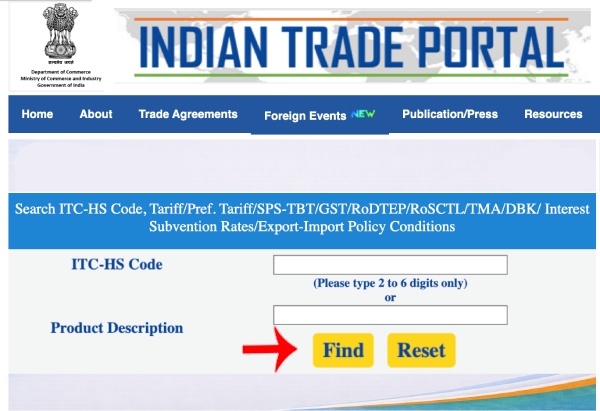
- Go to indiantradeportal.in
- Use the ITC-HS search tool on the homepage
- Enter your 8-digit code
- The result shows the applicable RoDTEP rate, Drawback rate, GST rate, and export policy condition all in one view
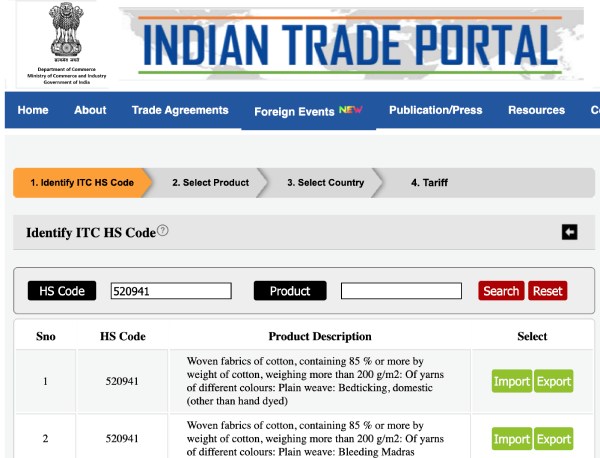
This is especially useful for manufacturers who want to verify their incentive eligibility before finalising their product classification.
Quick Chapter Reference – Common Indian Export Categories
If you are not sure where to start, this reference maps the most commonly exported Indian product categories to their ITC-HS chapters. Start here, then narrow down using the DGFT portal.
09
08
10 / 11
21
50-51
52
54-55
61-63
41-42
28-29
30
71
72-73
84
85
44 / 67
03
87
When Your Product Fits Two Codes – How to Decide
This is the most common real-world problem, and almost no article addresses it directly. Here are the situations Indian exporters face most often:
Example 1: A handmade leather bag that is also used as a laptop bag – it could be Chapter 42 (leather goods and travel bags) or Chapter 64 (footwear – no, wrong), or potentially Chapter 39 (plastics). The right answer depends on the primary material and essential character.
Example 2: A processed spice mix – it could be Chapter 9 (spices) if a single spice dominates, or Chapter 21 (food preparations) if it is a blended mixture.
Example 3: A cotton saree with silk border – Chapter 50 (silk) or Chapter 52 (cotton)? The answer depends on which fibre constitutes the greater part of the fabric’s weight.
The WCO’s General Rules for Interpretation (GRI) govern these decisions. In plain terms, apply them in this order:
- Specific over general – If one heading describes your product more specifically than another, use the specific one
- Essential character – For goods made of mixed materials, classify by the material that gives the product its essential character (usually the dominant material by weight, value, or function)
- Last in numerical order – If two headings are equally applicable after applying the above rules, use the one that comes last numerically in the tariff schedule
Most practical shortcut for Indian exporters: Ask your CHA (Customs House Agent) which code was used on your last shipping bill for the same product. That code has already been accepted by customs and creates a precedent for your future filings. Document the reasoning and keep it on file in case of an audit query.
Important: The legal responsibility for the correct HS code sits with you – the exporter – not your CHA, freight forwarder, or CA. Even if they suggest a code, you are liable for misclassification. Always understand the reasoning behind the code you use.
What Your ITC-HS Code Controls – Why Getting It Right Matters
Your HS code is not just an invoice field. It determines several critical outcomes for every shipment:
1. Export Policy Status
The code tells customs whether your product is freely exportable or needs a special licence. A product classified under the wrong code – even accidentally – and exported without the required licence can lead to seizure and penalties under the Foreign Trade (Development and Regulation) Act.
2. RoDTEP and Duty Drawback Rates
These export incentive schemes assign rebate rates at the ITC-HS code level. Two products that look similar but fall under different 8-digit codes may have completely different RoDTEP rates – or one may not be eligible at all. A wrong code can mean you either miss the benefit entirely or claim a rate you are not entitled to (which triggers recovery proceedings).
3. Customs Duty at the Destination Country
Your buyer’s customs authority uses your 6-digit HS code to calculate import duty on their end. A misclassified product that attracts a higher duty rate at the destination can damage your buyer relationship and make your pricing uncompetitive.
4. GSTR-1 HSN Summary
Your monthly GSTR-1 requires an HSN-wise summary of all supplies. Export invoices must be reported under the correct 8-digit code in Table 6A. Inconsistencies between your invoice HSN code and the code declared on the shipping bill can trigger GST scrutiny and delay IGST refund processing.
5. SCOMET Check
SCOMET stands for Special Chemicals, Organisms, Materials, Equipment and Technologies. Certain HS codes fall under SCOMET controls, meaning the goods are dual-use (civilian and potential military applications) and require a special export authorisation from DGFT before shipment. Always check the SCOMET list on the DGFT portal if your product is in chemicals (Chapter 28-38), electronics (Chapter 84-85), or aerospace/defence-related categories. Exporting a SCOMET item without authorisation is a serious legal violation.
💡 Expert Tip (Avadhut Taru): If your product falls under SCOMET (Special Chemicals, Organisms, Materials, Equipment, and Technologies), having a “Free” export policy isn’t enough. You will need a specific SCOMET Authorization from the DGFT. Exporting these items without it-even with a valid IEC-can lead to severe criminal penalties.
4 Common ITC-HS Code Mistakes Indian Exporters Make
- Using a 4 or 6-digit code on the Shipping Bill
Customs and ICEGATE require the full 8-digit ITC-HS code on every Shipping Bill. A shorter code will be rejected. This mistake is surprisingly common among first-time exporters whose CA or accountant has only referenced the 4-digit HSN for GST returns. - Copying the code from the foreign buyer or supplier
The buyer’s country uses the same first 6 digits but different last 2 digits. If you copy a US HTS code or a European CN code, the first 6 may be right but the last 2 will almost certainly be wrong for India. Always verify the full 8-digit code on the DGFT portal independently. - Not updating after the HS 2022 revision
The WCO revised the Harmonized System in January 2022 – approximately 351 amendments were made across various product categories. India implemented these with a short lag. If you have been using the same code since before 2022 without verifying, check whether your product’s code was affected. The next revision (HS 2027) is approaching – set a reminder to recheck in late 2026. - Using an import code (Schedule I) for an export shipment
Both schedules share the same code numbers, but the policy conditions can differ. If you look up your code on a website that defaults to the import schedule, you may see “Free” when the export schedule shows “Restricted.” Always confirm on the DGFT portal which schedule the result is from.
Once You Have Your ITC-HS Code – Next Step
Your ITC-HS code belongs on every export document: your commercial invoice, packing list, and shipping bill – and it must be consistent across all three. Discrepancies between documents are one of the top causes of customs holds and IGST refund rejections.
Our free Export Invoice Generator includes an 8-digit HSN/ITC-HS code field built in – alongside your GSTIN, IEC, LUT declaration, exchange rate, and all other mandatory export fields. Once you have found your correct code, you can put it on a fully compliant export invoice in minutes.
→ Create Your Export Invoice Free
Related Guides
- What is IEC Code – How to Apply for Import Export Code in India (2026) – Your IEC number must appear alongside your ITC-HS code on every Shipping Bill. Get your IEC first if you have not already.
- What is LUT in GST – How to File Form RFD-11 Before March 31 – Your ITC-HS code feeds directly into GSTR-1’s HSN summary under Table 6A, which links to your LUT-based zero-rated export reporting.
- Export Invoice Format in India – Mandatory Fields Under GST and Customs (2026) – See exactly where the 8-digit ITC-HS code appears on a compliant Indian export invoice and what other fields must accompany it.
What is ITC-HS code in India?
ITC-HS stands for Indian Trade Classification based on the Harmonized System. It is an 8-digit product classification code used by Indian customs and the DGFT for all import and export transactions. The first 6 digits follow the international Harmonized System developed by the World Customs Organization and are the same worldwide. The last 2 digits are India-specific and carry the national tariff item detail. The ITC-HS code determines customs duty, export policy status, and eligibility for export incentives like RoDTEP and Duty Drawback.
What is the difference between ITC-HS code and HSN code?
Both ITC-HS code and HSN code refer to the same underlying Harmonized System of product classification, but they are used in different contexts. HSN code is the term used in India’s GST system – on invoices, GST returns, and the GST portal. ITC-HS code is the term used for customs and DGFT purposes – on shipping bills, export applications, and trade policy documents. For export purposes, both refer to the 8-digit Indian classification, so the code itself is the same. The difference is only in context and which government portal uses which name.
How many digits is the HS code for export in India?
For export from India, you must always use the full 8-digit ITC-HS code on your Shipping Bill and export invoice. The international standard is 6 digits, but India extends this to 8 digits with two additional country-specific digits. Using a 4-digit or 6-digit code on an export document will be rejected by customs and ICEGATE. On domestic GST invoices, smaller businesses may use 4 or 6 digits depending on their turnover, but export documents always require 8 digits regardless of turnover.
Where can I find the ITC-HS code for my product?
The best official source for finding your product’s 8-digit ITC-HS code is the DGFT portal at dgft.gov.in. On the homepage, use the search bar that says ‘Search based on ITC(HS) Code or Product Description’ and type your product name in plain English. The portal shows you matching codes with their export policy conditions. You can also cross-check on the GST portal (gst.gov.in → Services → User Services → Search HSN Code) and on the Indian Trade Portal (indiantradeportal.in) which also shows RoDTEP and Duty Drawback rates for your code.
What happens if I use the wrong HS code on my export?
Using the wrong ITC-HS code on a Shipping Bill or export invoice can have several consequences: customs may hold the shipment for inspection and reclassification; you may be liable for duty differences plus penalties under the Customs Act (up to 4 times the evaded duty under Section 114A for gross negligence); your RoDTEP or Duty Drawback claim may be rejected or recovered if the wrong code was used to claim a higher rate; and IGST refund processing may be delayed if the code on your invoice does not match your Shipping Bill. Customs authorities can audit past shipments going back several years.
Is the HS code the same for import and export in India?
The 8-digit ITC-HS codes are the same numbers for both import and export, but the policy conditions attached to each code differ between Schedule I (imports) and Schedule II (exports). A product may be freely importable but restricted for export, or vice versa. Always check your product’s code under Schedule II (export) on the DGFT portal when planning an export shipment. Do not rely on an import-focused HS code list to determine your export eligibility.
Can I use the HS code provided by my buyer or freight forwarder?
You should verify any code provided by a buyer or freight forwarder independently on the DGFT portal before using it. Your buyer’s HS code uses their country’s national extension digits (the last 2 or 4 digits), which will be different from India’s. Your freight forwarder’s code may be outdated or based on a similar but different product. Most importantly, the legal responsibility for a correct HS code declaration sits with you – the exporter – not your agent or buyer. A wrong code, even if suggested by a third party, is your liability at Indian customs.
What is SCOMET and how does it relate to HS codes?
SCOMET stands for Special Chemicals, Organisms, Materials, Equipment and Technologies. It is India’s control list for dual-use goods – products that have both civilian and potential military or weapons applications. Certain ITC-HS codes fall under SCOMET controls, meaning you need a special export authorisation from DGFT before shipping those goods. The SCOMET list is published on the DGFT website. If your product is in chemicals (Chapters 28-38), advanced electronics (Chapters 84-85), or defence-adjacent categories, always check the SCOMET list before finalising your export. Exporting a SCOMET item without proper authorisation is a serious legal violation.
Do I need the ITC-HS code on my export invoice?
Yes. Your export commercial invoice must include the 8-digit ITC-HS code (also referred to as HSN code on the invoice). This is mandatory under GST rules for the GSTR-1 HSN-wise summary, and it must match the code declared on your Shipping Bill. Any discrepancy between the invoice HSN code and the Shipping Bill code can trigger GST scrutiny and delay your IGST refund or LUT-based export processing. You can generate a fully compliant export invoice with the HSN code field built in using the free Export Invoice Generator at impexkit.com/tools/export-invoice/

Avadhut Taru is the founder of ImpexKit, an engineer by background, and a researcher focused on simplifying import-export documentation and compliance for Indian businesses. Through detailed study of GST regulations, DGFT procedures, customs rules, and exporter compliance requirements, he creates practical tools and educational guides designed to make trade paperwork simpler, faster, and more accessible for Indian exporters.