
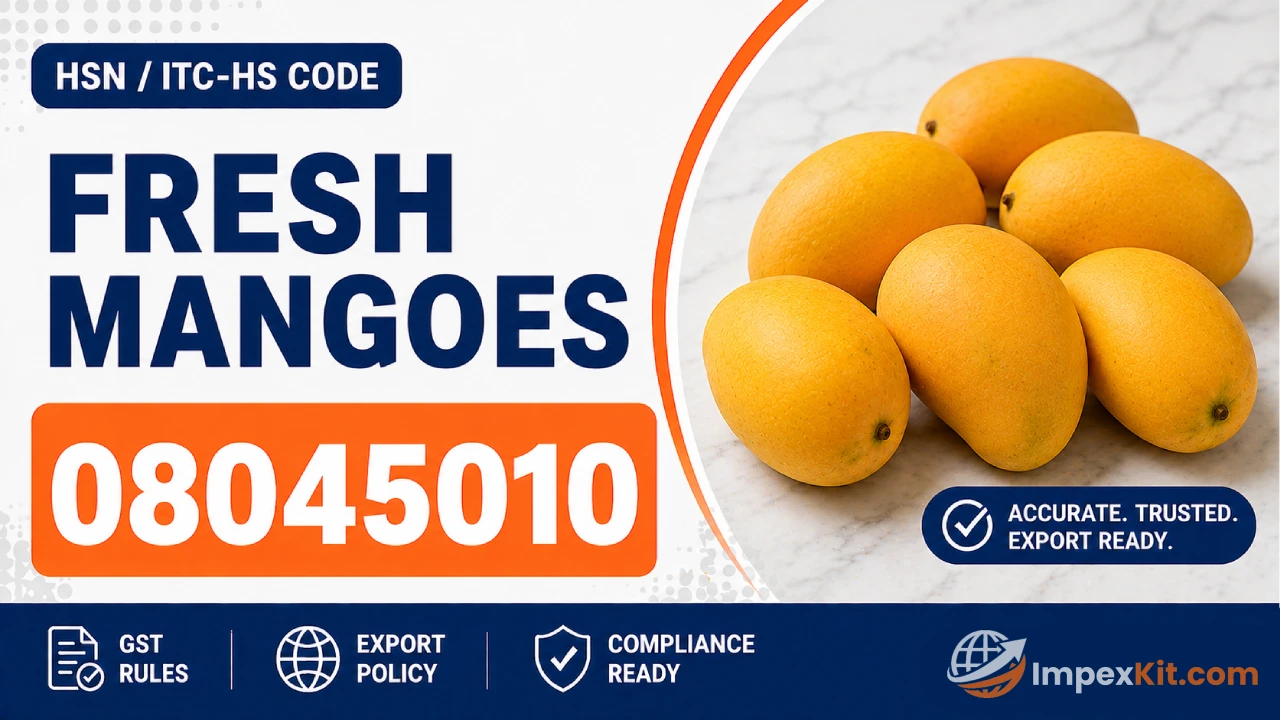
- Primary HSN Code: 08045010 (Fresh Mangoes)
- GST Rate: 0% (Exempt)
- Export Policy: FREE (APEDA & Mangonet Mandatory)
- RoDTEP (2026): Full Rates Restored (Notif 66/2025-26)
India is the world’s largest mango producer, with annual production exceeding 20 million tonnes. Fresh mango exports are India’s premium fruit export, valued at over USD 300 million annually, with major markets in the USA, UAE, EU, and Southeast Asia demanding year-round supply.
Maharashtra, Andhra Pradesh, and Uttar Pradesh are India’s leading mango-producing and exporting states – Alphonso from Maharashtra, Banganapalli from Andhra Pradesh, and Dasheri/Langra from UP are recognized varieties commanding premium prices globally. If you grow, trade, or export fresh mangoes, understanding the correct HSN code is essential for GST invoicing, export documentation, APEDA compliance, and claiming RoDTEP benefits.
This guide covers ITC-HS 08045010, the complete classification for fresh mangoes, along with GST rate, APEDA registration requirements, export policy, RoDTEP mechanics, and practical export tips for mango exporters across India’s major producing regions.
Many exporters also search for “mango HSN code” or “fresh mango export code” – both refer to ITC-HS 08045010 for whole fresh mangoes.
What Are Fresh Mangoes?
Fresh mangoes are the edible fruits of the mango tree (Mangifera indica) – harvested at mature-green stage or ripe stage and exported fresh (not processed, canned, or dried) to global markets. India exports hundreds of mango varieties, with Alphonso, Dasheri, Langra, Banganapalli, and Kesar varieties commanding the highest export values.
India’s mango farming spans multiple states with distinct harvest seasons – Maharashtra (March-May for Alphonso), Andhra Pradesh (April-June for Banganapalli), and Uttar Pradesh (June-August for Dasheri/Langra). This staggered harvest allows year-round export availability, making Indian mangoes a consistent global supply source.
HSN Code for Fresh Mangoes – 08045010
The correct HSN code for fresh mangoes is 08045010.
| Level | Code | Description |
|---|---|---|
| Chapter | 08 | Edible fruit and nuts; peel of citrus fruit or melon |
| Heading | 0804 | Dates, figs, pineapples, avocados, guavas, mangoes, mangosteens and similar fruit – fresh |
| Sub-heading | 080450 | Mangoes – fresh |
| 8-digit | 08045010 | Mangoes – fresh (all varieties) |
Quick breakdown:
- 08 → Chapter: Edible fruit and nuts
- 0804 → Heading: Tropical and subtropical fruit (dates, figs, mangoes, avocados, etc.)
- 080450 → Sub-heading: Mangoes – fresh (not dried, canned, or processed)
- 08045010 → Full 8-digit code for all fresh mango varieties
Use 08045010 on all GST invoices, e-way bills, shipping bills, and commercial export invoices for fresh mangoes – regardless of variety (Alphonso, Dasheri, Langra, Banganapalli, Kesar, etc.), whether ripe, mature-green, or in cartons/crates.
What About Processed Mango Products?
If your mango product is processed, the HSN code changes:
| Mango Form | HSN Code | When to Use |
|---|---|---|
| Fresh mangoes (whole fruit) | 08045010 | Standard export form |
| Mango pulp / puree (processed) | 20079990 | If pulped or processed into puree |
| Dried mango / mango chips | 08045030 | If dried or dehydrated |
| Mango juice / concentrate | 20096990 | If processed into juice/concentrate |
| Frozen mangoes | 08045090 | If frozen form (rare) |
Note: Dried mango slices generally fall under 08045030, but if they are preserved in sugar or syrup, they may move to Chapter 20.
The practical test: If mangoes are whole, ripe or mature-green, in natural fresh state – use 08045010. If they have been pulped, juiced, dried, or frozen – use the corresponding processed code. The processing form matters; always confirm the final product form before invoicing.
A helpful reference for fruit HSN codes: ITC-HS Code: How to Find the Right 8-Digit Export Code in India (2026)
GST Rate on Fresh Mangoes
GST rate: 0%
| Supply Type | Rate | Conditions |
|---|---|---|
| Domestic B2B supply (wholesale) | 0% | Unpackaged or bulk |
| Domestic B2C retail (packaged) | 0% | Retail crates/boxes |
| Interstate trade (B2B) | 0% | IGST rate |
| Export (with LUT) | Zero-rated | Zero GST |
Fresh mangoes under HSN 08045010 attract 0% GST for all domestic supplies – both wholesale and retail. This applies uniformly whether mangoes are sold loose, in crates, or packaged.
GST 2.0 Note: Fresh, unprocessed fruits like mangoes remain fully exempt (0% GST). This exemption was re-confirmed in the September 2025 GST overhaul to keep essential food items affordable. Processed mangoes (dried/sliced) may attract 5% or 12%, but whole fresh fruit is 0%.
For exports, IGST is zero-rated. Filing a Letter of Undertaking (LUT) before each financial year is standard practice for mango exporters – this allows shipment without paying IGST upfront and is critical for managing cash flow on bulk export orders, especially during peak season. Read: What is LUT in GST – How to File Form RFD-11 Before March 31
Export Policy for Fresh Mangoes
Export Policy: FREE
Fresh mangoes are classified under the Free export category as per Schedule II of India’s ITC-HS Export Policy. This means:
- No export licence required for fresh mangoes
- No quantity or value restriction on exports
- No prior DGFT approval needed
- A valid IEC (Importer Exporter Code) is the only mandatory baseline requirement to export
APEDA Registration – Mandatory for Export: While export policy is Free, APEDA (Agricultural & Processed Food Products Export Development Authority) registration is mandatory for all fresh mango exporters. APEDA registration is considered a standard compliance requirement for commercial mango exports from India.
- Obtain Export Registration Certificate (ERC) for mango exports
- Access quality assurance and certification support from APEDA
- File export customs bills with APEDA-registered exporter status
- Comply with phytosanitary and food safety certifications
- Access buyer connections and APEDA-backed trade fairs
⚠️ Mandatory Traceability (Mangonet): For 2026 exports to premium markets like the USA and EU, registration on APEDA’s Mangonet system is mandatory. Without farm-level traceability recorded in Mangonet, you cannot obtain the required Phytosanitary Certificate.
Fresh mango exporters without APEDA registration face customs clearance delays and cannot export. Registering with APEDA is available through their online portal (apeda.gov.in) and is a mandatory first step for all mango exporters in Maharashtra, Andhra Pradesh, UP, and other producing states.
Phytosanitary & Quality Requirements: International buyers require strict phytosanitary certification – proof that mangoes are free from pests and diseases, compliance with destination-country import regulations (USA, EU, Japan phytosanitary standards). Cold treatment (CT) protocols are standard for USA imports. EU buyers require maximum residue limit (MRL) compliance for pesticide residues. These standards do not change the HSN code but are critical for customs clearance at destination.
Regional Export Context: Maharashtra’s Alphonso (peak March-May) commands premium pricing in EU and USA markets. Andhra Pradesh’s Banganapalli and UP’s Dasheri follow in succession, providing year-round supply. Peak season exports (March-June) involve high-volume shipments and complex logistics – timing RoDTEP filing and maintaining APEDA compliance during peak harvest is critical.
If you are a mango farmer or exporter setting up exports for the first time, IEC registration is your starting point: What is IEC Code – How to Apply for Import Export Code in India (2026)
⭐ Expert Tip (Avadhut Taru): > If you are targeting premium markets like the USA or EU, simply having an APEDA registration is not enough. You must register your orchards on Mangonet to ensure “Farm-to-Fork” traceability. Additionally, ensure your Phytosanitary Certificate is issued by India’s NPPO/Plant Quarantine authority specifically mentioning compliance with the destination country’s treatment protocols (like Vapour Heat Treatment or Irradiation). Without proper digital traceability and treatment compliance, your shipment may face rejection or costly delays at the destination port.
RoDTEP and Duty Drawback for Fresh Mango Export
(Rates last verified: May 2026. Always confirm the latest Schedule from DGFT before filing.)
RoDTEP: Fresh mangoes under ITC-HS 08045010 are covered under India’s RoDTEP (Remission of Duties and Taxes on Exported Products) scheme. The applicable rate is notified by DGFT and revised periodically. Always check the current RoDTEP schedule at dgft.gov.in before filing your shipping bill.
2026 Update: As per Notification No. 66/2025-26, the 50% restriction on RoDTEP has been removed. Furthermore, Notification No. 74/2025-26 extends these restored rates for all exports made until September 30, 2026.
Duty Drawback: Mango exporters using imported inputs – such as imported packaging materials, imported refrigerated containers, imported labels, or imported handling equipment – may be eligible for All Industry Rate (AIR) drawback on customs duty paid for those inputs. Confirm the applicable drawback schedule with your CHA.
Working Capital Impact: Fresh mango exports typically involve perishable goods with tight export timelines – mangoes must be harvested, graded, packed, and shipped within 5-7 days to maintain quality. RoDTEP credit comes post-shipment, creating a working capital gap. Exporters must factor this into seasonal cash flow planning, especially during peak harvest season (March-June).
Seasonal Export Planning: Mango exports are highly seasonal, with peak season (March-June) concentrated in 3-4 months. Exporters should file RoDTEP claims quickly during peak season to access credit while managing high-volume shipments. Your export invoice must correctly state ITC-HS code 08045010, IEC, GSTIN, APEDA registration number, LUT or bond reference, variety name, and declared FOB value in foreign currency. Missing APEDA registration or incorrect fields can delay RoDTEP credit and customs clearance. Use the Export Invoice Generator to create a fully compliant India-specific export invoice – with all mandatory GST, APEDA, and customs fields built in.
Who Searches for HSN Code 08045010?
This article is relevant for:
- Mango farmers and orchards in Maharashtra (Ratnagiri, Sindhudurg), Andhra Pradesh (Chittoor, Nellore), and UP (Lucknow, Malihabad) filing GST returns on mango sales
- Mango exporters and consolidators sourcing from multiple farms and managing bulk fresh fruit exports
- Mango packhouses and cold storage operators handling grading, packing, and refrigeration for export quality standards
- Fruit traders and wholesalers sourcing mangoes for both domestic and export markets
- CAs and compliance consultants advising fruit sector clients on HSN classification and APEDA compliance
Practical example: An Alphonso mango exporter in Ratnagiri (Maharashtra) sources fruit from local orchards during peak season (March-May), transports to a packhouse for grading and cold treatment, then receives export orders from a distributor in the USA. The exporter confirms APEDA registration is current, classifies the shipment under ITC-HS 08045010 with variety name “Alphonso,” verifies cold treatment completion and phytosanitary certification, files a shipping bill, references their LUT on the commercial invoice to export without IGST, and claims RoDTEP credit post-shipment via ICEGATE.
Mango Varieties & Regional Production – Quality Tiers
Mango varieties and regional origins do not change the HSN code (all fresh mangoes use 08045010), but they significantly impact export pricing, buyer preference, and market positioning. Understanding these helps exporters target appropriate markets and command premium pricing:
| Variety / Region | Characteristics / Season | Export Market / Pricing Tier | Key Quality Standards |
|---|---|---|---|
| Alphonso (Maharashtra) | Golden-yellow, intense aroma, rich flavor, March-May | Premium EU, USA, UAE markets – Highest pricing | Minimum 250g, color grade A, <3% defects, GI certified |
| Banganapalli (Andhra Pradesh) | Golden-orange, sweet, good shelf life, April-June | USA, UAE, Southeast Asia – Medium-premium pricing | Minimum 200g, yellow color, <4% defects, good transportability |
| Dasheri / Langra (Uttar Pradesh) | Medium-large, creamy texture, June-August | EU, USA, domestic export channels – Medium pricing | Minimum 180g, firm texture, <5% defects, late-season advantage |
| Kesar (Gujarat / Rajasthan) | Golden-orange, high sugar content, June-July | Premium international markets – Premium pricing | Minimum 200g, golden color, <3% defects, GI certified |
These variety names and regional origins (Alphonso from Ratnagiri, Banganapalli from Chittoor, Dasheri from Lucknow) are recognized by international buyers and command specific price premiums. These regional identifications help exporters communicate quality tier and geographic origin. All varieties use HSN 08045010 regardless of type or origin – the HSN code does not distinguish between varieties.
Export Documentation for Fresh Mango Shipments
Beyond HSN code and APEDA registration, fresh mango exporters must prepare several compliance documents for successful customs clearance and buyer satisfaction. Key documents include:
- APEDA Export Registration Certificate (ERC)
- Phytosanitary Certificate: Issued by India’s Plant Quarantine / NPPO (National Plant Protection Organization) authority. This confirms the mangoes meet the health standards of the destination country.
- Cold treatment (CT) certificate if applicable (USA requirement)
- Packing list with variety, grade, size specifications
- Commercial invoice with HSN 08045010, variety name, LUT reference, FOB value
- Shipping bill / Bill of Lading with APEDA exporter status
- Certificate of Origin (if required by destination country)
For a complete export documentation checklist: Documents Required for Export from India – Complete 2026 Checklist
Frequently Asked Questions
What is the HSN code for fresh mangoes?
The HSN code for fresh mangoes (whole fruit, all varieties) is 08045010. This 8-digit ITC-HS code is used on GST invoices, e-way bills, shipping bills, and all export documentation. The code applies to all mango varieties – Alphonso, Dasheri, Langra, Banganapalli, Kesar, etc. – regardless of ripeness stage or origin.
What is the GST rate on fresh mangoes?
Fresh mangoes (HSN 08045010) are exempt from GST (0%). Only processed mango products attract GST.
Is fresh mango export free or restricted in India?
Fresh mangoes are in the Free export category under Schedule II of India’s Foreign Trade Policy. However, APEDA registration is mandatory for all mango exporters. Without APEDA registration, customs clearance will be delayed and export benefits cannot be claimed.
What is the difference between HSN 08045010 and 08045090?
08045010 is for fresh mangoes (whole fruit, natural fresh state). 08045090 is for other processed or frozen mangoes. Use 08045010 for standard fresh mango exports; use 08045090 only if mangoes are frozen.
Is APEDA registration mandatory for mango export?
Yes. APEDA registration is mandatory for all fresh mango exporters. It is required to obtain Export Registration Certificate (ERC), file export customs bills correctly, and access export benefits including RoDTEP. Exporters without APEDA registration face customs delays. Register on the APEDA portal (apeda.gov.in).
What phytosanitary requirements apply to fresh mango exports?
International buyers require phytosanitary certificates proving mangoes are free from pests and diseases. USA imports require cold treatment (CT) compliance. EU buyers require maximum residue limit (MRL) compliance for pesticide residues. These standards do not change the HSN code but are critical for destination customs clearance.
Are fresh mango exports eligible for RoDTEP?
Yes. Fresh mangoes under ITC-HS 08045010 are covered under the RoDTEP scheme. The applicable rate is notified and revised by DGFT – check the current schedule at dgft.gov.in before filing your shipping bill. RoDTEP credit comes post-shipment, so plan working capital accordingly during peak season exports.
Which Indian mango varieties command the highest export prices?
Alphonso from Maharashtra (March-May) commands the highest premium prices in EU and USA markets due to its distinctive aroma and flavor – often 2-3x higher than standard varieties. Kesar from Gujarat is also premium-priced. Banganapalli from Andhra Pradesh and Dasheri from UP follow in pricing tiers. All use HSN 08045010 regardless of variety.

Avadhut Taru is the founder of ImpexKit, an engineer by background, and a researcher focused on simplifying import-export documentation and compliance for Indian businesses. Through detailed study of GST regulations, DGFT procedures, customs rules, and exporter compliance requirements, he creates practical tools and educational guides designed to make trade paperwork simpler, faster, and more accessible for Indian exporters.