
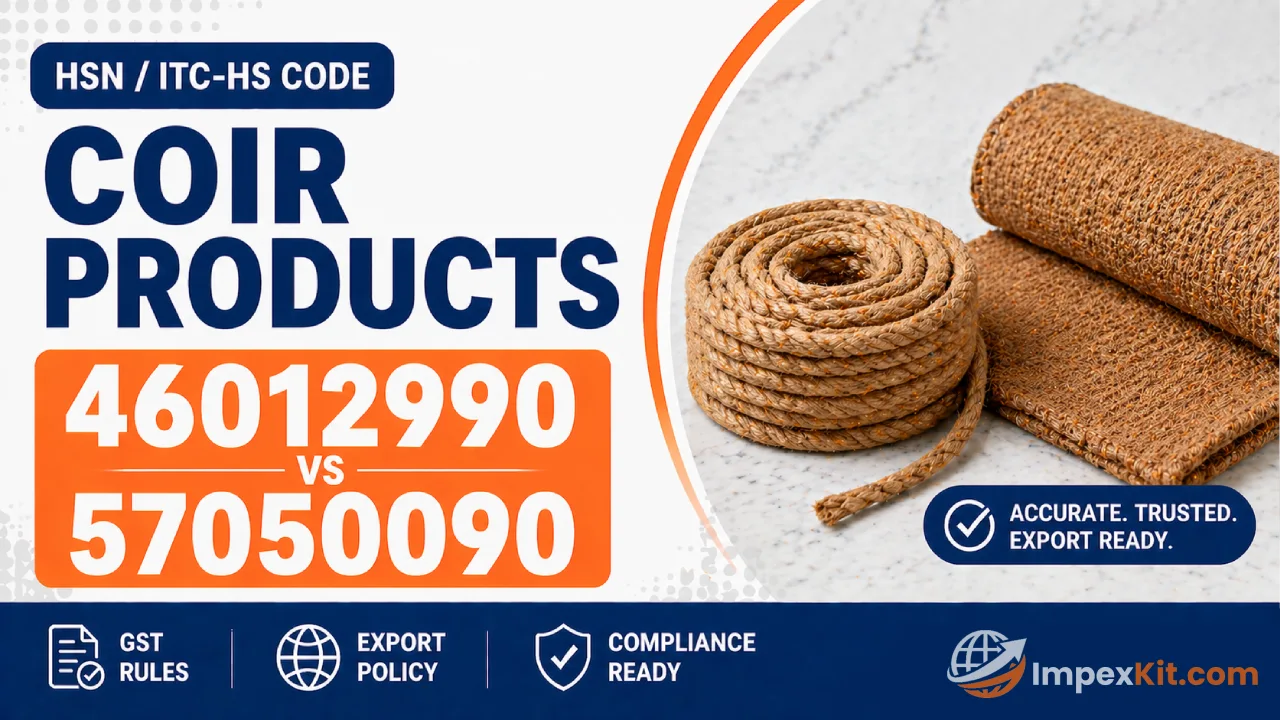
- Primary HSN Codes: 46012990 (Ropes) & 57050090 (Mats)
- GST Rate: 5% (Concessional rate for natural fibre handicrafts)
- Export Policy: FREE (No licence required)
- RoDTEP Rate (2026): 1.5% to 2.1% (Full rates restored per Notif. 66/2025-26)
Coir (coconut fibre) is one of India’s most important natural fibre export products, with Kerala accounting for over 80% of India’s coir production and export. Coir products – from rope and twine to mats, carpets, geotextiles, and horticultural substrate – are exported globally to markets in Europe, North America, and Southeast Asia.
But coir product classification under HSN is complex – different coir articles fall under different chapters and codes depending on their form and end use. This guide covers the two primary HSN codes for coir products: 46012990 (coir rope and cordage) and 57050090 (coir mats and carpets) – along with GST rate, export policy, and practical tips for Kerala exporters.
46012990 → Coir rope, twine, and cordage
57050090 → Coir mats, carpets, and floor coverings
GST Rate: 5% (most products)
Export Policy: Free
Key Rule: Classification depends on product form (rope vs floor covering)
What Are Coir Products?
Coir (coconut fibre) is the fibrous material extracted from the husk of coconut. Coir products are manufactured items made from processed coir fibre – including rope, twine, yarn, mats, carpets, pads, geotextiles, and horticultural growing media.
Kerala’s coir industry produces a wide range of finished coir articles for both domestic and international markets. The sector employs thousands of artisans and small manufacturers, particularly in districts like Ernakulam, Kannur, Alappuzha, and Thiruvananthapuram.
HSN Code for Coir Products – 46012990 vs 57050090
Coir products are classified under two main HSN codes depending on the product form. The choice between them is determined by the final product type, not the raw material:
HSN 46012990 – Coir Rope and Cordage
Use 46012990 for coir rope, twine, cord, and cordage products.
| Level | Code | Description |
|---|---|---|
| Chapter | 46 | Manufactures of straw, esparto or other plaiting materials; basketware and wickerwork |
| Heading | 4601 | Plaited or woven articles of straw, of rattan, of reeds, of willow, of bamboo or of other plaiting materials |
| Sub-heading | 460129 | Other plaited articles of coir and other vegetable materials |
| 8-digit | 46012990 | Coir rope, twine, and cordage (various forms including twisted or braided) |
HSN 57050090 – Coir Mats, Carpets & Textiles
Use 57050090 for coir mats, carpets, rugs, geotextiles, and textile products made from coir fibre.
| Level | Code | Description |
|---|---|---|
| Chapter | 57 | Carpets and other textile floor coverings |
| Heading | 5705 | Other carpets and textile floor coverings, whether or not made up |
| Sub-heading | 570500 | Other textile floor coverings (including coir-based) |
| 8-digit | 57050090 | Coir mats, carpets, rugs, and floor coverings |
Quick Decision Guide
Use 46012990 if your coir product is:
- Rope or twine (twisted or plaited coir fibre)
- Cordage or braided cord
- Raw coir yarn (unprocessed into floor coverings)
Use 57050090 if your coir product is:
- Coir mats and doormats
- Coir carpets and rugs
- Coir geotextiles (for erosion control and landscaping)
- Coir growing media / horticultural substrate
- Coir pads and cushioning materials
- Finished floor coverings made from coir
Important note: If you are uncertain which code applies to your specific coir product, consult your CHA or the DGFT ITC-HS classification portal. A helpful reference: ITC-HS Code: How to Find the Right 8-Digit Export Code in India (2026)
GST Rate on Coir Products
GST Rate on Coir Products (2.0 Update):
- 5% GST: Applies to Coir Mats, Matting, Carpets, Coir Pith, and Coir Fibre (HSN 5702, 4601, 5305).
- 12% GST: Applies primarily to specific composite carpets (Coir + Jute mixes) or non-floor covering textiles under HSN 5705.
- 0% GST: Raw Coir Yarn (HSN 5308) is zero-rated.
Breakdown for 5% Items: CGST 2.5%, SGST 2.5% (or IGST 5%). For exports, IGST is Zero-rated with an LUT.
⚠️ GST 2.0 Note (2026 Accuracy): While many general HSN websites still list Chapter 46 and 57 articles at 12%, the 56th GST Council Meeting (and subsequent September 2025 revisions) moved coir mats, matting, and floor coverings to the concessional 5% slab.This change was made to support the natural fibre industry in Kerala and TN. If you are a composite manufacturer (using coir mixed with rubber or synthetics), consult your CA as these specific blends may still attract a higher rate.
Filing a Letter of Undertaking (LUT) before each financial year is standard practice for coir exporters – this allows shipment without paying IGST upfront. Read: What is LUT in GST – How to File Form RFD-11 Before March 31
Export Policy for Coir Products
Export Policy: FREE
Finished coir products under both 46012990 and 57050090 are classified under the Free export category as per Schedule II of India’s ITC-HS Export Policy. This means:
- No export licence required for finished coir products
- No quantity or value restriction
- No prior DGFT or government approval needed
- A valid IEC (Importer Exporter Code) is the only mandatory baseline requirement
Quality & Certification Note: While India’s export policy is free, international buyers – particularly from the EU and North America – increasingly require certifications for natural fibre products: GOTS (Global Organic Textile Standard) for organic coir products, ISO standards for mechanical properties, and sometimes chemical composition certifications. These are buyer-side requirements, not Indian regulations, but failing to meet them can block shipments at the destination port.
COIR Board & Export Support: The Coir Board (Ministry of MSME) actively supports coir product exporters through export promotion schemes, buyer-seller meets, and international trade fair participation. Kerala coir exporters should explore Coir Board membership and export assistance programs – these often provide market development support, buyer connections, and subsided participation in international exhibitions.
Classification must always be based on the final product form, not the raw coir fibre.
If you are a Kerala coir exporter setting up direct exports for the first time, IEC registration is your starting point: What is IEC Code – How to Apply for Import Export Code in India (2026)
⭐ Expert Tip (Avadhut Taru): For coir exports, Fumigation is non-negotiable. While the Coir Board offers voluntary inspection, most US and EU buyers will demand a Phytosanitary Certificate and a Fumigation Certificate (Methyl Bromide treatment). Ensure your CHA arranges this at the port to avoid shipment rejection or costly delays at the destination port.
RoDTEP and Duty Drawback for Coir Products
RoDTEP: Coir products under ITC-HS 46012990 and 57050090 are covered under India’s RoDTEP (Remission of Duties and Taxes on Exported Products) scheme. The applicable rate is notified by DGFT and revised periodically. Always check the current RoDTEP schedule at dgft.gov.in before filing your shipping bill – rates for natural fibre products are revised regularly.
RoDTEP Benefits (April 2026 Status):
- Restoration (Exact Rates): As per Notification No. 66/2025-26, the full rates are back. For your specific products:
- HSN 46012990 (Coir Rope): The restored rate is 1.5%.
- HSN 57050090 (Coir Mats): The restored rate is 2.1%.
- Extension: Per Notification No. 74/2025-26, this scheme is now extended for all exports made until September 30, 2026.
- Action: Ensure your Shipping Bill intent is marked “Y” for RoDTEP to claim your e-scrip credits.
Duty Drawback: Coir product manufacturers using imported inputs – such as imported dyes, imported binding materials, or imported machinery parts – may be eligible for All Industry Rate (AIR) drawback on customs duty paid for those inputs. Confirm with your CHA.
Kerala State Support: The Kerala government, through the Kerala Coir Development Corporation (KCDC) and state MSME schemes, provides additional export financing, technology upgradation support, and cluster development assistance for coir exporters – often in combination with Coir Board benefits.
Your export invoice must correctly state the applicable ITC-HS code (46012990 or 57050090 – whichever applies), IEC, GSTIN, LUT or bond reference, and declared FOB value in foreign currency. Missing or wrong fields can delay RoDTEP credit. Use the Export Invoice Generator to create a fully compliant India-specific export invoice – with all mandatory GST and customs fields built in and no manual formatting errors.
Who Searches for HSN Code for Coir Products?
This article is relevant for:
- Kerala coir manufacturers and exporters in Ernakulam, Kannur, Alappuzha, and Thiruvananthapuram filing GST returns and e-way bills
- Coir product exporters shipping rope, mats, carpets, and geotextiles to buyers in Europe, North America, and Asia
- Coir artisans and cottage industry units producing handmade coir items for domestic wholesale and export
- Trading companies and export agents consolidating coir shipments from multiple Kerala manufacturers
- CAs and compliance consultants advising coir sector clients on HSN classification and export documentation
Practical example: A coir rope manufacturing unit in Kannur produces twisted coir rope and twine from locally sourced coconut fibre, packs them in export-ready bundles, and receives a purchase order from a marine cordage distributor in Netherlands. They classify the shipment under ITC-HS 46012990, file a shipping bill, reference their LUT on the commercial invoice to export without paying IGST, and claim RoDTEP credit post-shipment via ICEGATE.
How to Use Coir HSN Codes in Your Paperwork
To ensure your Kerala coir shipment clears customs without queries in 2026, follow this roadmap:
- Category 1 (One-Time Setup): Verify your IEC Code is updated in the April-June window and your LUT (Form RFD-11) is filed for the 2026-27 financial year.
- Category 2 (Shipment-Specific): Mention the 8-digit HSN on your Export Invoice and Packing List. Ensure your RCMC from the Coir Board is active to claim RoDTEP benefits.
🔗 Related: Check the Full Checklist of Documents Required for Export from India
Frequently Asked Questions
What is the HSN code for coir products?
Coir products have two primary HSN codes depending on the form: 46012990 for coir rope, twine, and cordage; and 57050090 for coir mats, carpets, rugs, and floor coverings. The correct code depends on the final product type, not the raw material.
Is coir product export free or restricted in India?
Finished coir products are in the Free export category under Schedule II of India’s Foreign Trade Policy. No export licence or DGFT approval is required – only a valid IEC code. However, buyers in the EU and North America may require certifications like GOTS or ISO standards.
Which coir products use HSN 46012990 vs 57050090?
Use 46012990 for coir rope, twine, and cordage. Use 57050090 for coir mats, carpets, rugs, geotextiles, and floor coverings. If you produce both types in the same export shipment, each must appear on the shipping bill under its own correct code.
Are coir products eligible for RoDTEP?
Yes, coir products are eligible. As of April 2026, the restored RoDTEP rates are 2.1% for coir mats and 1.5% for coir ropes under Notification 66/2025-26.
Does the Coir Board provide export support for coir exporters?
Yes. The Coir Board (Ministry of MSME) offers export promotion schemes, buyer-seller meets, and subsidized participation in international trade fairs. Kerala-based coir exporters should explore Coir Board membership and state-level support through KCDC and Kerala MSME schemes alongside RoDTEP and duty drawback benefits.
What is the GST rate on coir products?
Finished coir products like mats, ropes, and pith attract a concessional GST rate of 5%. Some composite carpets or specific mixtures may attract 12%. Exports are zero-rated.
Is fumigation mandatory for coir export?
Yes. Since coir is an organic plant fibre, most countries (especially the USA, Australia, and the EU) require a Fumigation Certificate and a Phytosanitary Certificate to prevent pest transmission.

Avadhut Taru is the founder of ImpexKit, an engineer by background, and a researcher focused on simplifying import-export documentation and compliance for Indian businesses. Through detailed study of GST regulations, DGFT procedures, customs rules, and exporter compliance requirements, he creates practical tools and educational guides designed to make trade paperwork simpler, faster, and more accessible for Indian exporters.