
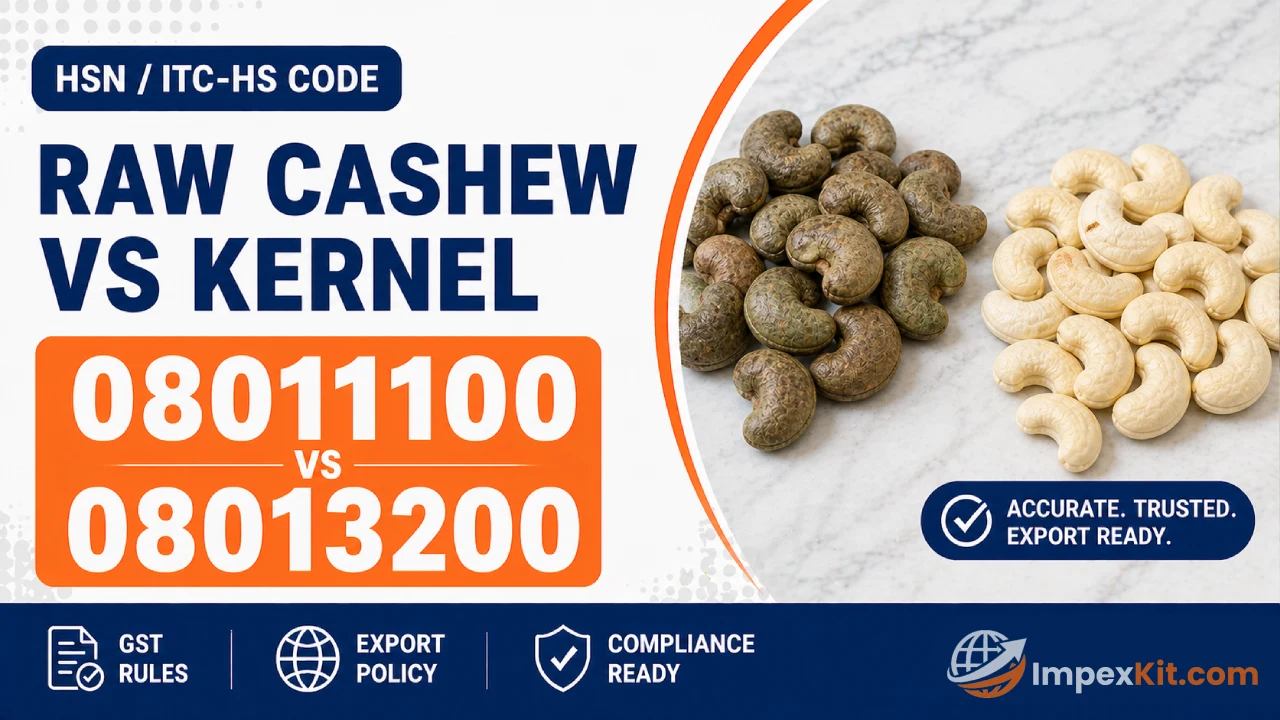
- Raw Cashew (Import): HSN 08011100 (In Shell) | GST: 5%
- Cashew Kernels (Export): HSN 08013200 (Shelled) | GST: 5%
- Import Duty (RCN): 25% (Basic Customs Duty)
- Export RoDTEP (2026): 1.2% (Full rate restored per Notif. 66/2025-26)
India is the world’s largest processor of cashew nuts, importing raw cashew nuts (RCN) from Africa, Vietnam, and other suppliers, then shelling and processing them into finished kernels for export. But for importers and processors, the HSN classification confusion between raw cashew nuts (in shell) and processed kernels (shelled) creates serious GST, import duty, and customs documentation errors.
This guide resolves the classification split clearly: raw cashew nuts use HSN 08011100 (for imports), while shelled cashew kernels use HSN 08013200 (for export). Understanding the difference is critical for correct import duty calculation, GST treatment, and export benefit claims.
08011100 → Raw cashew nuts (in shell, import)
08013200 → Cashew kernels (shelled, export)
GST Rate: 5%
Import Duty (RCN): ~25%
RoDTEP: ~1.2% (check DGFT)
Key Rule: Classification depends on processing stage (raw vs shelled)
What Are Raw Cashew Nuts vs Cashew Kernels?
Raw cashew nuts (RCN) are the unprocessed fruit of the cashew tree – still in their natural shell with the kernel inside. They are imported into India in dried form from African suppliers (Tanzania, Mozambique, Guinea-Bissau) and Vietnamese processors.
Cashew kernels are the edible portion extracted after shelling, drying, sorting, and processing the raw nuts – a completely different product form. India imports raw cashew nuts and converts them domestically into finished kernels for re-export as a value-added product.
HSN Code Split – Raw vs Processed Cashew
This is where most processors get confused. The HSN split within Chapter 08 (Edible fruit and nuts) is critical:
HSN 08011100 – Raw Cashew Nuts (in Shell)
| Level | Code | Description |
|---|---|---|
| Chapter | 08 | Edible fruit and nuts; peel of citrus fruit or melons |
| Heading | 0801 | Coconuts, Brazil nuts and cashew nuts, fresh or dried |
| Sub-heading | 080111 | Cashew nuts – in shell (unshelled) |
| 8-digit | 08011100 | Raw cashew nuts (RCN) – dried, in natural shell form |
Use 08011100 for:
- Raw, unshelled cashew nuts imported for processing
- Cashew nuts still in their natural shell (dried or fresh)
- RCN from African suppliers (Tanzania, Mozambique, etc.) or Vietnamese processors
HSN 08013200 – Processed Cashew Kernels (Shelled)
| Level | Code | Description |
|---|---|---|
| Chapter | 08 | Edible fruit and nuts; peel of citrus fruit or melons |
| Heading | 0801 | Coconuts, Brazil nuts and cashew nuts, fresh or dried |
| Sub-heading | 080132 | Cashew nuts – shelled (kernel form) |
| 8-digit | 08013200 | Cashew kernels – shelled, dried, blanched or roasted |
Use 08013200 for:
- Processed cashew kernels (shelled and dried)
- Whole pieces, splits, blanched, roasted, or salted kernels
- Finished products ready for consumption or food industry use
- Kernels exported from India to international markets
Quick Decision Guide
Always classify cashew products based on their processing stage, not just the raw material.
| Characteristic | Raw Cashew Nuts (08011100) | Cashew Kernels (08013200) |
|---|---|---|
| Physical form | Still in shell, intact | Shelled, extracted, dried |
| Processing stage | Unprocessed, raw | Processed, value-added |
| Direction of trade | Import into India | Export from India |
| GST rate | 5% | 5% |
| Primary user | Domestic processors, millers | International buyers, consumers |
The practical test: If the cashew is still in its shell and unprocessed – it’s 08011100. If the shell has been removed and the kernel extracted – it’s 08013200. Never use these codes interchangeably.
For detailed guidance on finding the correct nut and dried fruit codes: ITC-HS Code: How to Find the Right 8-Digit Export Code in India (2026)
GST Rate – Import vs Export Difference
Raw Cashew Nuts (08011100)
| Transaction Type | GST Rate |
|---|---|
| Import (customs + GST) | IGST 5% (in addition to customs duty) |
| Domestic supply (B2B/B2C) | IGST 5% |
| Inter-state trade | IGST 5% |
Raw cashew nuts (RCN) imported into India attract 5% IGST in addition to the Basic Customs Duty. For domestic purchases from farmers, GST is paid at 5% under Reverse Charge Mechanism (RCM). This 5% IGST paid during import is fully claimable as Input Tax Credit (ITC), which you can use to offset the tax on your final kernel sales.
GST Treatment: Kernels (Forward Charge) vs. Raw Nuts (RCM)
While both products attract a 5% GST rate, the way you pay it is different:
- Cashew Kernels (08013200): These fall under Forward Charge. You charge 5% to your buyer on the invoice.
- Raw Cashew Nuts (08011100): These often fall under Reverse Charge (RCM). If you buy from a farmer, you (the buyer) pay the 5% tax directly to the government.
Cashew Kernels (08013200)
| Transaction Type | GST Rate |
|---|---|
| Domestic B2B/B2C supply | IGST 5% (concessional) |
| Inter-state trade | IGST 5% |
| Export | Zero-rated (LUT) |
Processed cashew kernels attract 5% GST for domestic supply – a lower rate reflecting their food product status. For exports, IGST is zero-rated when filing a Letter of Undertaking (LUT).
GST 2.0 Note: The 5% rate for raw nuts (Chapter 08) and 5% rate for processed nuts remain stable through the post-September 2025 GST 2.0 revision. Verify on cbic-gst.gov.in before importing or invoicing to confirm no changes to import GST treatment or processed nut rates.
For export, filing LUT is standard practice for cashew kernel exporters: What is LUT in GST – How to File Form RFD-11 Before March 31
Customs Duty on Raw Cashew Nut Imports
Import Customs Duty (RCN): ~25% (subject to change)
Raw cashew nuts imported into India face basic customs duty of approximately 25% on the CIF (Cost, Insurance, Freight) value. This duty is separate from GST and is a direct cost for processors.
Customs Duty Calculation Example (for reference only): If you import 100 tonnes of RCN valued at USD 2,000 per tonne (CIF), the customs duty is 25% × USD 200,000 = USD 50,000. When converted to INR and added to your import cost, this becomes a significant production expense that must be factored into export pricing and profitability.
Drawback Eligibility: Processors importing RCN can claim duty drawback (typically 5-7% of export value) on the finished kernel exports – partially offsetting the import duty paid. Confirm the current drawback schedule with your CHA before each shipment.
Important: Customs duty rates are subject to periodic revision by the Government of India. Always verify the current RCN import duty with your Customs House Agent (CHA) or the CBIC (Central Board of Indirect Taxes & Customs) website before importing.
Export Policy – Cashew Nuts vs Kernels
Raw Cashew Nuts (08011100): RESTRICTED for export
India does not export raw cashew nuts (RCN) – these are restricted for export under the Foreign Trade Policy. Raw nuts are imported, processed domestically, and only the finished kernels are exported.
Cashew Kernels (08013200): FREE export category
Finished cashew kernels are classified under the Free export category as per Schedule II of India’s ITC-HS Export Policy. This means:
- No export licence required for finished kernels
- No quantity or value restriction
- No prior DGFT approval needed
- A valid IEC (Importer Exporter Code) and APEDA registration are mandatory for kernel export (not for import)
APEDA Requirement Clarification: APEDA registration is mandatory for cashew kernel export but not for RCN import. Processors importing RCN need IEC (for customs purposes), but APEDA registration is required only when exporting finished kernels.
If you are a cashew processor setting up import and export operations for the first time, IEC registration is your starting point: What is IEC Code – How to Apply for Import Export Code in India (2026)
RoDTEP and Drawback – Processor Benefit
RoDTEP on Kernel Exports: Finished cashew kernels (08013200) exported from India are covered under the RoDTEP scheme. Check the current rate at dgft.gov.in before filing your shipping bill.
May 2026 Update: Per DGFT Notification No. 66/2025-26, the full RoDTEP rates have been restored. For HSN 08013200, the rate is now 1.2%, valid for exports made until September 30, 2026 under Notification No. 74/2025-26.
Duty Drawback on RCN Import: This is the key financial benefit for processors. When you import RCN (08011100), you pay customs duty (~25%). When you export the processed kernels (08013200), you can claim duty drawback – effectively getting a refund or credit on a portion of the import duty paid.
Drawback Claim Process: The drawback is claimed on the export invoice for finished kernels. Your CHA will manage the drawback documentation and submission to customs. Current AIR (All Industry Rate) drawback for cashew kernels is typically 5-7% of export value, but confirm the exact rate before each shipment.
Note: Drawback rates are subject to value caps (₹ per kg); verify the latest Schedule with your CHA before final costing.
Working Capital Impact: Processors must factor in the import duty-to-export refund cycle when calculating working capital needs. Large RCN imports can tie up significant capital in duty payments before drawback is claimed on kernel exports.
Your export invoice must correctly state ITC-HS 08013200, IEC, GSTIN, APEDA registration number, and export value. Use the Export Invoice Generator to create a fully compliant India-specific export invoice – with all mandatory fields for RoDTEP and drawback claim documentation.
Who Searches for Raw Cashew Nut HSN Code?
This article is relevant for:
- Cashew processors and millers in Goa, Kerala, Maharashtra importing RCN and filing import customs bills
- RCN importers and traders consolidating African and Vietnamese cashew supplies for domestic processor distribution
- Cashew exporters managing both import (RCN) and export (kernels) documentation and benefit claims
- Customs brokers and CHA agents handling RCN import declarations and drawback filings
- CAs and compliance consultants advising cashew sector clients on HSN classification and import/export strategy
Practical example: A cashew processing unit in Goa imports 500 tonnes of RCN from Tanzania classified under HSN 08011100, processes them into finished kernels (08013200), and exports the kernels to buyers in the USA and Europe. They correctly classify import bills under 08011100 (paying 5% IGST + applicable customs duty), claim duty drawback on the kernel exports under 08013200, file LUT for zero-rated kernel export, and claim RoDTEP credit post-shipment via ICEGATE.
Raw Cashew Nut Sourcing – Geographic Origins & Trade Names
India imports raw cashew nuts from several geographic sources, each known by trade names based on origin. Understanding these helps processors communicate with international suppliers and understand supply chain documentation:
| Origin Country | RCN Grade / Trade Name | Characteristics | Volume to India |
|---|---|---|---|
| Tanzania | Tanzanian RCN / TZA | High-quality, larger nuts, white kernels | Largest supplier to India |
| Mozambique | Mozambique RCN / MOZ | Medium quality, mixed kernel color | Second-largest supplier |
| Guinea-Bissau | Guinea-Bissau RCN / GW | Lower moisture, good quality | Significant supply |
| Ivory Coast | Ivory Coast RCN / CIV | Premium quality, white kernels | Limited supply to India |
| Vietnam | Vietnamese Processed RCN | Pre-processed, shelled pieces (may use 08013200) | Growing import |
These geographic origins and trade grades do not change the HSN code – all raw nuts (regardless of origin) use 08011100 for import, and all shelled kernels (regardless of source) use 08013200 for export. However, these trade names appear in purchase orders, import customs bills, and seller documentation, so processors should be familiar with them.
💡 Expert Tip (Avadhut Taru): When importing RCN (08011100), customs will scrutinize your CIF value. Ensure your contract matches current market rates in African origins; otherwise, customs may assess duty on a higher ‘standard’ value, significantly increasing your cost.
Frequently Asked Questions
What is the HSN code for raw cashew nuts?
The HSN code for raw cashew nuts (in shell, unprocessed) is 08011100. This is used for importing cashew nuts from African and Vietnamese suppliers. Once shelled and processed into kernels, the code changes to 08013200.
What is the GST rate on raw cashew nuts vs cashew kernels?
Both Raw Cashew Nuts (08011100) and Cashew Kernels (08013200) attract 5% GST. However, for Raw Nuts, it is often paid under Reverse Charge (RCM) or as Import IGST. For Kernels, it is a standard 5% Forward Charge. Exports are always Zero-rated under LUT.
What is the difference between HSN 08011100 and 08013200?
08011100 is for raw cashew nuts still in their natural shell (unprocessed). 08013200 is for shelled, dried cashew kernels (processed). Never use these codes interchangeably – they have different GST rates, customs duties, and export policies.
Can India export raw cashew nuts?
No. Raw cashew nuts (RCN) are restricted for export under India’s Foreign Trade Policy. India only exports finished cashew kernels (08013200). Raw nuts are imported, processed domestically, and only finished kernels are exported.
What is the customs duty on raw cashew nut imports?
Raw cashew nut imports face basic customs duty of approximately 25% on CIF value (subject to periodic revision). This duty applies in addition to 5% GST. Processors can claim partial duty drawback (5-7% of export value) when exporting finished kernels.
Do processors need APEDA registration for RCN import or kernel export?
APEDA registration is mandatory for kernel export but not for RCN import. Processors importing RCN need IEC (Importer Exporter Code) for customs purposes. APEDA registration is required only when exporting finished kernels to obtain Export Registration Certificate (ERC).

Avadhut Taru is the founder of ImpexKit, an engineer by background, and a researcher focused on simplifying import-export documentation and compliance for Indian businesses. Through detailed study of GST regulations, DGFT procedures, customs rules, and exporter compliance requirements, he creates practical tools and educational guides designed to make trade paperwork simpler, faster, and more accessible for Indian exporters.