
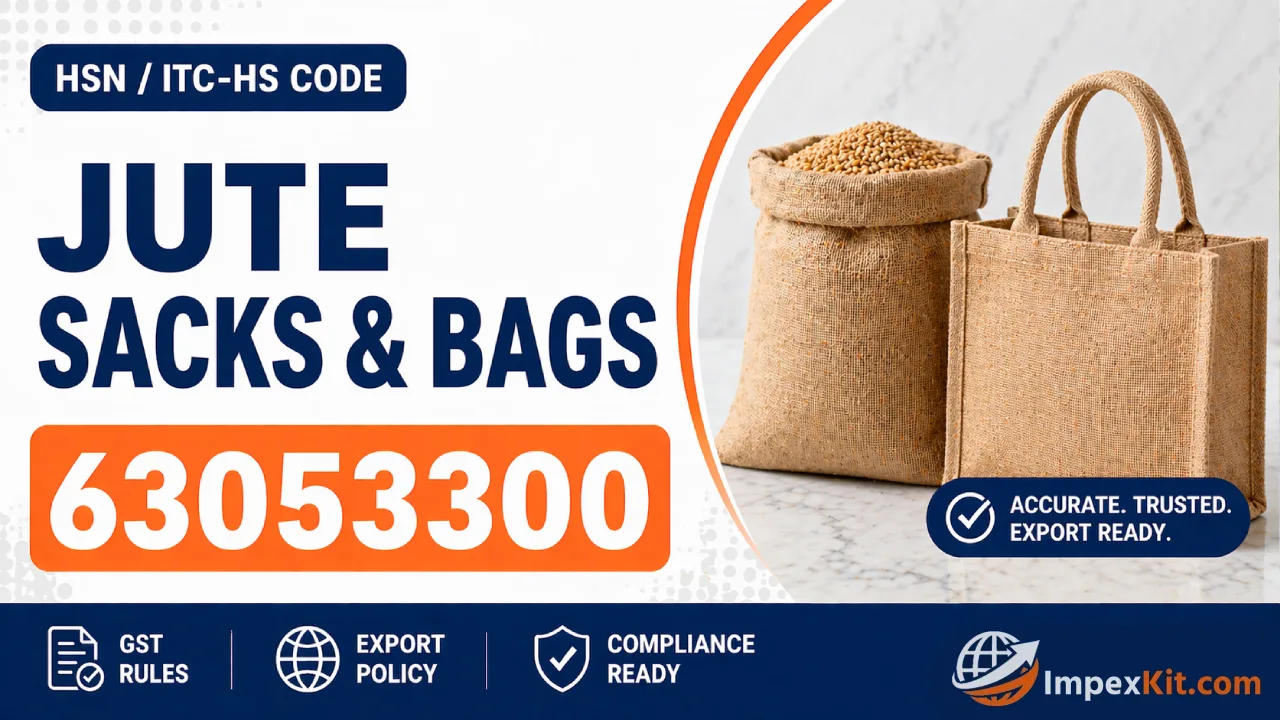
- Primary HSN Code: 63053300
- GST Rate: 5%
- Export Policy: Free (No License Required)
- Chapter: 63 – Other made-up textile articles
Jute bags are one of India’s most important eco-friendly export products, with the EU, UK, USA, and Australia among the largest buyers. India – led by West Bengal – accounts for the majority of global jute bag production. If you manufacture, trade, or export jute bags, knowing the correct HSN code is essential for GST compliance, shipping bills, and export benefit claims.
This guide covers ITC-HS code 63053300, the correct GST rate, export policy, EU compliance considerations, and RoDTEP applicability – in one place, with no fluff.
What Are Jute Bags?
Jute bags are flexible packaging and carrying bags woven from jute fibre – a natural, biodegradable plant-based material. They are used as shopping bags, produce bags, promotional totes, sacking bags, and export-grade packaging for food commodities like coffee, cocoa, and grains.
Jute bags exported from India typically fall into two broad categories: hessian bags (open-weave, used for agricultural commodities) and finished tote/shopping bags (printed, laminated, or stitched with handles, sold to retail and FMCG buyers). Both use the same HSN code but may differ in buyer specification and compliance requirements.
India’s jute manufacturing is concentrated in West Bengal, with IJMA (Indian Jute Mills Association) member mills and smaller MSME units both active in export supply chains.
Popular Jute Bag Varieties for Export
India is the world leader in jute manufacturing, and buyers typically source these specific types under HSN 63053300:
- Hessian Sacks: Standard open-weave bags used for coffee beans, cocoa, and potatoes.
- Jute Tote Bags: High-end, printed bags used by retail chains in Europe and the USA.
- Promotional Bags: Eco-friendly branded bags for events and corporate gifting.
- B-Twill Bags: Heavy-duty bags specifically designed for packing 50kg to 100kg of food grains.
HSN Code for Jute Bags – 63053300
The correct HSN / ITC-HS code for jute bags is 63053300.
| Level | Code | Description |
|---|---|---|
| Chapter | 63 | Other made-up textile articles; sets; worn clothing and worn textile articles; rags |
| Heading | 6305 | Sacks and bags, of a kind used for the packing of goods |
| Sub-heading | 630533 | Of jute or other textile bast fibres – other |
| 8-digit | 63053300 | Jute bags and sacks – other than those of heading 630510 or 630520 |
⭐ Expert Tip (Avadhut Taru): HSN 63053300 is primarily for sacks used for packing goods. If you are exporting laminated tote bags, ensure the jute remains the dominant material by weight. If the plastic lining becomes too heavy, Customs may reclassify it under Chapter 39 or 42. Always declare “Natural Jute Fiber Dominant” on your Export Invoice to ensure a smooth 5% GST and RoDTEP claim.
Quick breakdown:
- 63 → Chapter: Other made-up textile articles
- 6305 → Heading: Sacks and bags used for packing goods
- 630533 → Sub-heading: Jute or bast fibre bags – other types
- 63053300 → Full 8-digit ITC-HS code for jute bags
Use 63053300 on all GST invoices, e-way bills, shipping bills, and commercial export invoices for jute bags – whether hessian sacks, tote bags, shopping bags, or promotional bags made from jute.
⚠️ Common Mistake: Many exporters wrongly use HSN 63053300 for jute fabric or yarn. This code applies only when the product is a finished bag or sack. Raw jute materials fall under Chapter 53.
Note on related codes: Jute yarn falls under Chapter 53. Jute fabric (uncut/unsewn) falls under Chapter 53 headings – not Chapter 63. Chapter 63 applies only when the jute has been made up into a bag or sack form. If you are unsure whether your product is “fabric” or “made-up bag,” confirm with your CHA before filing the shipping bill.
GST Rate on Jute Bags
GST rate: 5%
| Tax Component | Rate |
|---|---|
| CGST | 2.5% |
| SGST | 2.5% |
| IGST (interstate supply) | 5% |
| Export | Zero-rated |
Jute bags attract 5% GST across all supply types – retail, bulk, and B2B. This low rate reflects the government’s support for jute as a natural and eco-friendly material aligned with the Jute Packaging Materials (Compulsory Use in Packing Commodities) Act.
For exports, IGST is zero-rated. Most jute exporters file a Letter of Undertaking (LUT) before each financial year to export without paying IGST upfront, preserving working capital across large bulk orders. Read: What is LUT in GST – How to File Form RFD-11 Before March 31
Verify the current rate at cbic-gst.gov.in before invoicing, particularly if you supply laminated or coated jute bags, which may attract a different treatment depending on the dominant material.
Export Policy for Jute Bags
Export Policy: FREE
Jute bags under ITC-HS 63053300 are classified under the Free export category as per Schedule II of India’s Foreign Trade Policy. This means:
- No export licence required
- No quantity or value restriction on exports
- No prior DGFT approval needed
- A valid IEC (Importer Exporter Code) is the only mandatory requirement to begin exporting
EU and UK Market Note: While India’s export policy is free, buyers in the EU and UK increasingly require compliance documentation for jute bags – including REACH compliance for dyes and finishes, OEKO-TEX or similar certifications for retail-grade bags, and country-of-origin certificates. These are buyer-side requirements, not Indian export restrictions, but failing to meet them can block shipments at the destination port.
Mandatory Jute Packaging (Domestic Market): Under the Jute Packaging Materials Act, certain domestic commodities – including foodgrains and sugar – must be packed in jute bags for a mandated percentage of their production. This is a domestic procurement rule, not an export restriction, but it affects jute bag demand and pricing for mills.
If you are setting up jute bag exports for the first time, getting your IEC is the first step: What is IEC Code – How to Apply for Import Export Code in India (2026)
RoDTEP and Duty Drawback for Jute Bags
RoDTEP: Jute bags under ITC-HS 63053300 are covered under India’s RoDTEP (Remission of Duties and Taxes on Exported Products) scheme. The applicable rate is notified by DGFT and revised periodically. Always check the current RoDTEP schedule at dgft.gov.in before filing your shipping bill – RoDTEP rates for jute products have been revised multiple times since the scheme’s launch.
Duty Drawback: Jute bag manufacturers using imported inputs – such as imported dyes, pigments, synthetic handles, or metal fittings – may be eligible for All Industry Rate (AIR) drawback on the customs duty paid for those inputs. Confirm the applicable drawback schedule and rates with your Customs House Agent (CHA) before shipment.
JMDC Assistance: The Jute Manufactures Development Council (JMDC) under the Ministry of Textiles periodically offers export promotion support and market development assistance (MDA) for jute product exporters. MSME jute bag manufacturers should check eligibility for these schemes alongside RoDTEP.
Exporters should also register with the National Jute Board (NJB) to access the Export Market Assistance (EMA) scheme, which provides subsidies for participating in international exhibitions.
A correctly prepared export invoice is the foundation for every RoDTEP and drawback claim. Missing fields – IEC, GSTIN, LUT reference, ITC-HS code, or FOB value – can delay or cancel your credit. Use the Export Invoice Generator to create a fully compliant, India-specific export invoice with all GST and customs fields correctly built in.
Who Searches for HSN Code 63053300?
This article is relevant for:
- Jute mills and MSME manufacturers in West Bengal filing GSTR-1 and GSTR-3B with correct HSN classification
- Eco-product exporters shipping jute shopping bags, tote bags, and promotional bags to EU, UK, and US buyers
- Agricultural commodity traders using jute sacks for packaging and needing correct B2B invoice codes
- Export agents and buying houses sourcing jute bags for overseas retail and FMCG clients
- CAs and compliance consultants advising jute sector clients on correct Chapter 63 classification and RoDTEP eligibility
Practical example: A jute bag manufacturer in Kolkata receives a purchase order from a supermarket chain in Germany for 50,000 printed jute shopping bags. They classify the shipment under ITC-HS 63053300, file a shipping bill, reference their LUT on the commercial invoice to export without IGST, provide an OEKO-TEX compliance certificate to satisfy the German buyer’s requirement, and claim RoDTEP credit post-shipment via ICEGATE.
Frequently Asked Questions
What is the HSN code for jute bags?
The HSN code for jute bags is 63053300. This 8-digit ITC-HS code covers jute sacks and bags used for packing goods – including hessian sacks, shopping bags, tote bags, and promotional bags made from jute fibre.
What is the GST rate on jute bags?
Jute bags attract 5% GST – 2.5% CGST and 2.5% SGST for intra-state supply, or 5% IGST for interstate transactions. Exports are zero-rated under GST.
Is jute bag export free or restricted in India?
Jute bags are in the Free export category under Schedule II of India’s Foreign Trade Policy. No export licence or DGFT approval is required. Only a valid IEC code is needed to begin exporting.
Are jute bags eligible for RoDTEP?
Yes. Jute bags under ITC-HS 63053300 are covered under the RoDTEP scheme. The applicable rate is notified by DGFT and revised periodically – check the current schedule at dgft.gov.in before filing your shipping bill.
Do EU buyers require special certification for jute bags from India?
India’s export policy has no restrictions, but EU and UK retail buyers commonly require REACH compliance documentation for dyes and finishes, and OEKO-TEX or equivalent certification for retail-grade jute bags. These are buyer-side requirements – not Indian regulations – but they must be met to avoid rejection at the destination port.

Avadhut Taru is the founder of ImpexKit, an engineer by background, and a researcher focused on simplifying import-export documentation and compliance for Indian businesses. Through detailed study of GST regulations, DGFT procedures, customs rules, and exporter compliance requirements, he creates practical tools and educational guides designed to make trade paperwork simpler, faster, and more accessible for Indian exporters.