
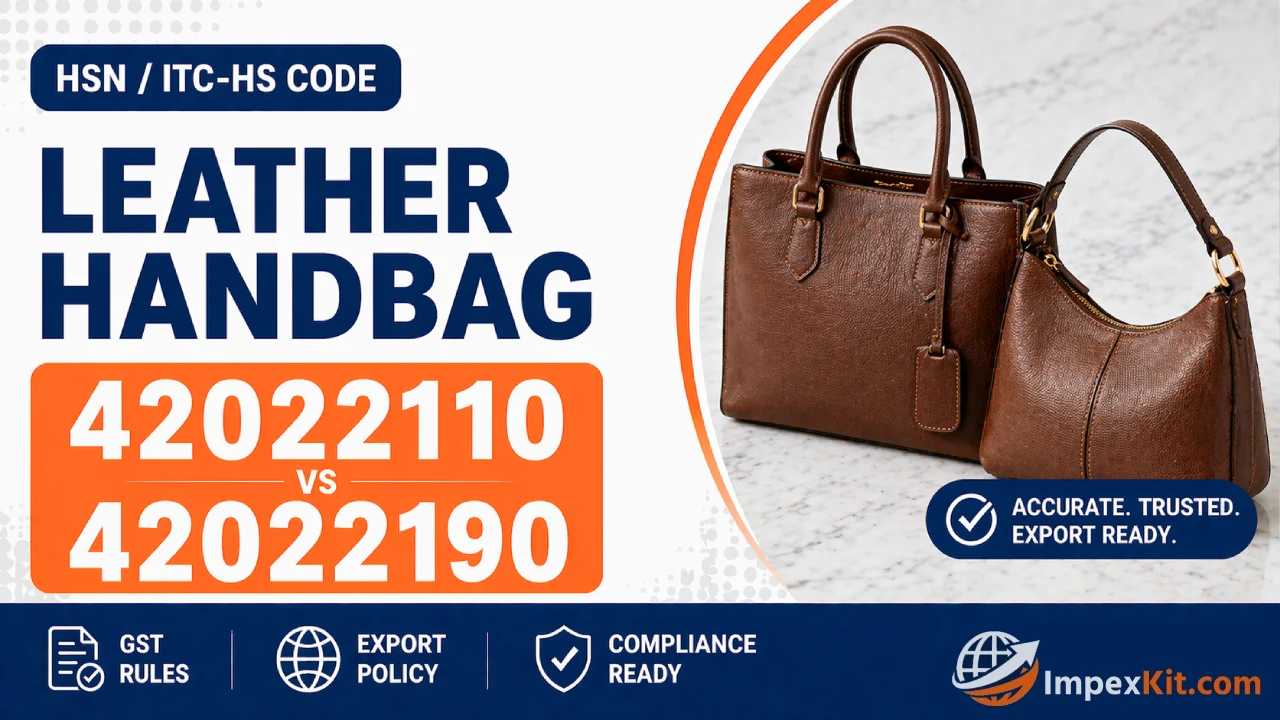
- Primary HSN Code: 42022110 (Ladies) | 42022190 (Other)
- GST Rate: 18%
- Export Policy: Free (No License Required)
- Chapter: 42 – Articles of Leather
- 2026 RoDTEP Rate: 1.5% (Restored)
India is a major global supplier of leather handbags, with manufacturing clusters in Chennai, Kanpur, Kolkata, and Dharavi (Mumbai). Leather handbags are exported to buyers in Europe, the USA, Japan, and the Gulf – both as private-label production for international brands and as original designs from Indian exporters.
But unlike most products with a single clean HSN code, leather handbags have a classification split within Chapter 42 that most exporters and CAs get wrong: 42022110 vs 42022190. This guide resolves that confusion directly – along with GST rate, export policy, and RoDTEP applicability.
What Is a Leather Handbag?
A leather handbag is a carried personal bag – with handles or a shoulder strap – made with an outer surface of leather or composition leather. It is used for everyday carry, fashion, travel, and business purposes.
India exports leather handbags across a wide range: structured tote bags, slouchy shoulder bags, satchels, clutches, crossbody bags, and doctor bags. Both genuine leather and composition leather (bonded leather, split leather with a leather surface layer) fall under the same Chapter 42 classification framework – the sub-type within Chapter 42 depends on the specific product design, not just the material.
HSN Code for Leather Handbag – 42022110 vs 42022190
Both 42022110 and 42022190 sit within the same heading and sub-heading. The difference is in the final 2 digits – which denote a further product split within the “handbags with outer surface of leather” sub-heading. Here is the full breakdown:
| Level | Code | Description |
|---|---|---|
| Chapter | 42 | Articles of leather; travel goods, handbags and similar containers |
| Heading | 4202 | Trunks, suitcases, handbags, wallets, and similar articles |
| Sub-heading | 420221 | Handbags, whether or not with shoulder strap – with outer surface of leather or composition leather |
| 8-digit Option A | 42022110 | Ladies handbags – outer surface of leather or composition leather |
| 8-digit Option B | 42022190 | Other handbags – outer surface of leather or composition leather (not specifically ladies handbags) |
Classification is determined by the material covering the greatest surface area of the outer shell. If leather is only used for trims/handles, use HSN 420222 (Textile surface) instead.
⚠️ Note on Mixed Materials: If your handbag is a blend of leather and textile (like a canvas bag with leather handles), the classification depends on which material covers the greatest surface area. If the outer surface is 51% or more textile, you must move to Chapter 4202.32 instead of 4202.21.
⭐ Expert Tip (Avadhut Taru): While Indian Customs focuses on the “Ladies vs. Other” split, international buyers (especially in Italy and France) focus on Chemical Compliance. Ensure your leather is REACH compliant (free from Chromium VI). Mentioning “REACH Compliant Leather” on your Export Invoice is often more important for closing a deal than the HSN code itself.
Additionally, for EU and UK markets, ensure your leather is REACH compliant (free from Chromium VI and harmful dyes). International buyers often ask for a REACH declaration certificate before placing bulk orders.
The practical decision rule:
- Use 42022110 for handbags designed and marketed as ladies handbags – totes, shoulder bags, clutches, satchels, and crossbody bags specifically positioned as women’s accessories
- Use 42022190 for leather handbags that are not specifically ladies handbags – this includes gender-neutral bags, unisex carry bags, and leather bags that do not fit the standard ladies handbag description
⚠️ Common Mistake: Many exporters classify handbags only based on material (leather) and ignore product positioning. The split between 42022110 and 42022190 depends on whether the bag is designed and marketed as a ladies handbag. Misclassification can lead to GST mismatch and customs queries.
In practice, the majority of leather handbag exports from India use 42022110 – because most production is for women’s fashion accessories. If you manufacture both types in the same shipment, each must appear on the shipping bill under its own correct code.
What about backpacks and briefcases? Leather backpacks fall under 42029210 / 42029290 (rucksacks with outer surface of leather). Leather briefcases and attache cases fall under 42021110 / 42021190. Do not use 42022110 or 42022190 for these – the heading 4202 splits by bag type before it splits by material.
If you are classifying leather goods across multiple bag types in one export shipment, this guide will help you navigate ITC-HS systematically: ITC-HS Code: How to Find the Right 8-Digit Export Code in India (2026)
GST Rate on Leather Handbag
GST rate: 18%
| Tax Component | Rate |
|---|---|
| CGST | 9% |
| SGST | 9% |
| IGST (interstate supply) | 18% |
| Export | Zero-rated |
Both 42022110 and 42022190 attract 18% GST – the code split does not affect the tax rate. The 18% rate applies uniformly across all leather handbag types under heading 4202 with outer surface of leather.
GST 2.0 Note: The 18% rate for Chapter 42 leather goods has remained unchanged through the post-September 2025 GST 2.0 revision. Verify on cbic-gst.gov.in before invoicing, particularly for composite bags where a non-leather material may form the dominant surface.
For exports, IGST is zero-rated. Filing a Letter of Undertaking (LUT) before each financial year is the standard practice for leather handbag exporters – it allows you to export without paying IGST upfront and avoids tying up working capital in refund cycles. Read: What is LUT in GST – How to File Form RFD-11 Before March 31
Export Policy for Leather Handbags
Export Policy: FREE
Leather handbags under both 42022110 and 42022190 are classified under the Free export category as per Schedule II of India’s ITC-HS Export Policy. This means:
- No export licence required
- No quantity or value restriction on exports
- No prior DGFT or government approval needed
- A valid IEC (Importer Exporter Code) is the only mandatory baseline requirement
Chapter 41 vs Chapter 42 reminder: The Free export status applies to finished leather handbags (manufactured goods) under Chapter 42. Raw hides, wet blue leather, and semi-processed leather under Chapter 41 face separate export restrictions and export duties. These do not apply to finished bags.
CLE Registration: Registration with the Council for Leather Exports (CLE) is strongly recommended for handbag exporters. CLE connects Indian manufacturers with international buyers, facilitates participation in trade fairs like Mipel (Milan) and Hong Kong International Leather Fair, and provides access to market development assistance. Premium international buyers – including those sourcing private-label handbags for brands like Da Milano style positioning or European department stores – often prefer CLE-registered suppliers.
If you are a leather goods manufacturer setting up exports for the first time, IEC registration is your first step: What is IEC Code – How to Apply for Import Export Code in India (2026)
RoDTEP and Duty Drawback for Leather Handbags
RoDTEP (Restored April 2026): As per the latest DGFT notification, the temporary 50% restriction on rates has been lifted. For Leather Handbags (42022110 / 42022190), the full RoDTEP rate of 1.1% is now active. To claim this, ensure you mark your “Intent to Claim RoDTEP” on the shipping bill. You can track your scroll status and e-scrip credits on the ICEGATE portal.
RoDTEP: Leather handbags under ITC-HS 42022110 and 42022190 are covered under India’s RoDTEP (Remission of Duties and Taxes on Exported Products) scheme. The applicable rate is notified by DGFT and revised periodically – always check the current RoDTEP schedule at dgft.gov.in before filing your shipping bill.
As of March 23, 2026, the full RoDTEP rates have been restored to 1.5% for handbags.
Check the ‘Per Piece’ value cap in the RoDTEP Appendix 4R, as the rebate is often capped at a maximum amount per unit regardless of the total invoice value.
Duty Drawback: Handbag manufacturers using imported inputs – such as imported hardware (buckles, D-rings, magnetic clasps, chain straps), imported lining fabric, or imported leather – may be eligible for All Industry Rate (AIR) drawback on customs duty paid for those inputs. Confirm the applicable schedule and rates with your CHA before shipment.
Your export invoice must correctly state the applicable ITC-HS code (42022110 or 42022190 – whichever applies to your product), IEC, GSTIN, LUT or bond reference, and declared FOB value in foreign currency. A wrong code at the invoice stage flows through to the shipping bill and can delay RoDTEP credit. Use the Export Invoice Generator to create a fully compliant India-specific export invoice – with all mandatory GST and customs fields built in and no manual formatting errors.
Who Searches for HSN Code for Leather Handbag?
This article is relevant for:
- Leather handbag manufacturers in Chennai, Kanpur, Kolkata, and Dharavi filing GSTR-1 and GSTR-3B with correct Chapter 42 codes
- Fashion accessory exporters shipping women’s handbags, totes, satchels, and clutches to EU, UK, US, and Japan buyers
- Private-label suppliers producing leather bags for Indian fashion brands like Hidesign, Baggit, and Caprese and needing correct HSN for B2B invoices
- Buying agents and sourcing houses consolidating multi-SKU leather goods shipments with mixed bag types in one container
- CAs and export compliance consultants resolving the 42022110 vs 42022190 split for leather goods clients
Practical example: A leather goods manufacturer in Chennai produces two product lines for an export order – 300 structured women’s tote bags (ladies handbags) and 150 unisex leather carry bags. They correctly classify the totes under ITC-HS 42022110 and the unisex bags under 42022190 on separate line items of the shipping bill, reference their LUT on the commercial invoice, and submit separate RoDTEP claims post-shipment for each ITC-HS line via ICEGATE.
HSN for Premium Indian Leather Brands
If you are a retailer or distributor for premium Indian brands like Hidesign, Da Milano, Baggit, Nappa Dori, or Caprese, the HSN classification for their genuine leather handbags remains 42022110. All these brands attract the 18% GST rate for domestic B2B sales and 0% for international exports with an LUT.
Frequently Asked Questions
What is the HSN code for leather handbag?
The HSN code for leather handbag is either 42022110 (ladies handbags with outer surface of leather) or 42022190 (other handbags with outer surface of leather, not specifically ladies). Most women’s fashion handbags exported from India use 42022110.
What is the difference between HSN 42022110 and 42022190?
42022110 applies to ladies handbags – bags designed and marketed specifically as women’s accessories (totes, shoulder bags, clutches, satchels). 42022190 applies to other leather handbags not specifically classified as ladies handbags – including gender-neutral and unisex carry bags. Both attract the same 18% GST rate.
What is the GST rate on leather handbag?
Leather handbags attract 18% GST – 9% CGST and 9% SGST for intra-state supply, or 18% IGST for interstate transactions. This rate applies to both 42022110 and 42022190. Exports are zero-rated under GST.
Is leather handbag export free or restricted in India?
Finished leather handbags are in the Free export category under Schedule II of India’s Foreign Trade Policy. No export licence or DGFT approval is required – only a valid IEC code. Raw hides and semi-finished leather under Chapter 41 face separate restrictions, but these do not apply to finished handbags.
Does the same HSN code apply to leather backpacks and briefcases?
No. Leather backpacks use HSN 42029210 or 42029290. Leather briefcases and attache cases use 42021110 or 42021190. HSN 42022110 and 42022190 apply specifically to handbags – not rucksacks or briefcases. Always classify by bag type first, then by outer surface material.

Avadhut Taru is the founder of ImpexKit, an engineer by background, and a researcher focused on simplifying import-export documentation and compliance for Indian businesses. Through detailed study of GST regulations, DGFT procedures, customs rules, and exporter compliance requirements, he creates practical tools and educational guides designed to make trade paperwork simpler, faster, and more accessible for Indian exporters.