
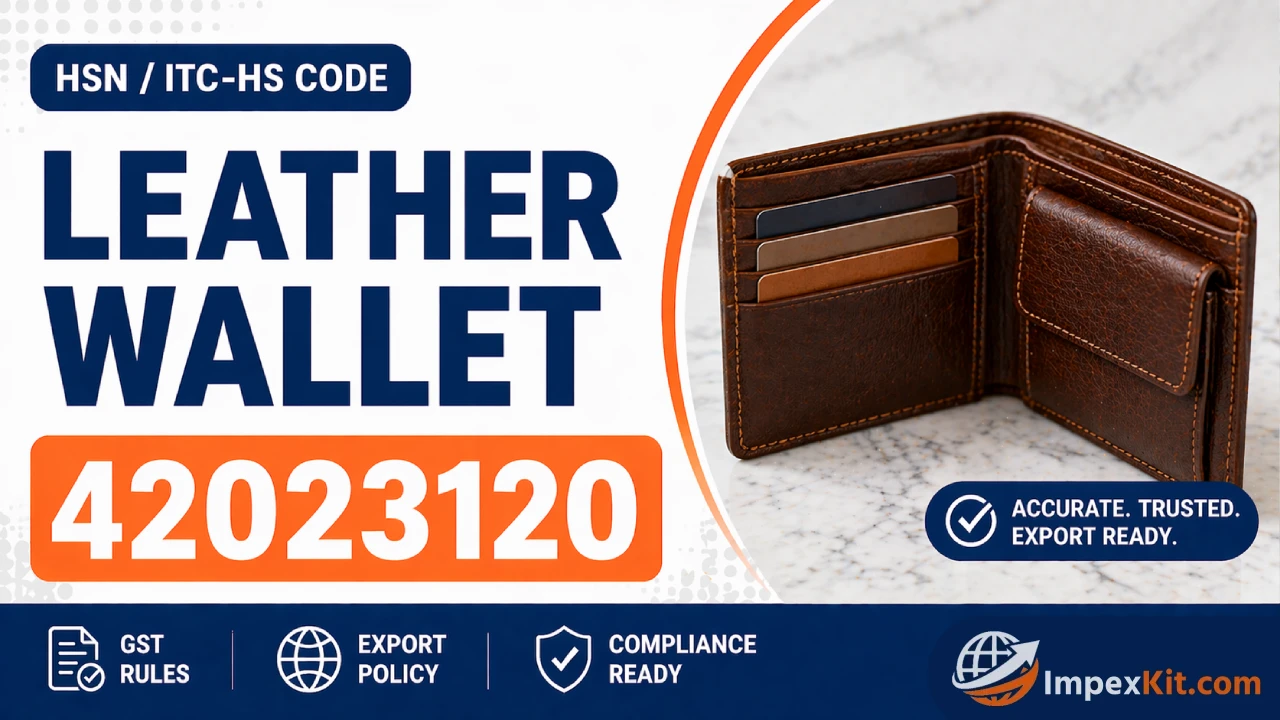
- Primary HSN Code: 42023120
- GST Rate: 18%
- Export Policy: Free (No License Required)
- Chapter: 42 – Articles of leather; travel goods, handbags and similar containers
- RoDTEP Rate (2026): 1.1% (Full rate restored as of March 23, 2026)
India is one of the world’s largest producers and exporters of leather goods, with Agra, Kanpur, Chennai, and Kolkata as major manufacturing hubs. Leather wallets – ranging from mass-produced FMCG grade to handcrafted artisan pieces – are exported to buyers in Europe, the USA, Japan, and the Gulf. For GST invoicing, shipping bills, and export documentation, using the correct HSN code under Chapter 42 is non-negotiable.
This guide covers ITC-HS code 42023120, the correct GST rate, export policy, and practical tips for small leather goods exporters and artisans – going well beyond the raw SEAIR data pages that currently dominate this topic online.
What Is a Leather Wallet?
A leather wallet is a flat, folding case made from leather – used for carrying currency notes, cards, and identity documents. It falls under the broader category of personal leather goods alongside cardholders, key pouches, and document wallets.
Indian manufacturers produce leather wallets across a wide range – from plain bifold wallets in buffalo leather to RFID-blocking cardholders in full-grain cowhide, hand-stitched artisan pieces for premium export buyers, and private-label orders for international brands. The product you make determines whether your wallet is “with outer surface of leather” (Chapter 42) or a different classification – the surface material is the deciding factor under HSN rules.
HSN Code for Leather Wallet – 42023120
The correct HSN code for a leather wallet (outer surface of leather or composition leather) is 42023120.
| Level | Code | Description |
|---|---|---|
| Chapter | 42 | Articles of leather; saddlery and harness; travel goods, handbags and similar containers |
| Heading | 4202 | Trunks, suitcases, handbags, wallets, purses and similar articles |
| Sub-heading | 420231 | Articles of a kind normally carried in the pocket or handbag – with outer surface of leather or composition leather |
| 8-digit | 42023120 | Wallets, purses and similar articles – outer surface of leather |
⭐ Expert Tip (Avadhut Taru): European buyers (Germany, Italy, France) are extremely strict about REACH Compliance. This ensures your leather is free from harmful chemicals like Hexavalent Chromium (Cr VI). Always ask your tannery for a “REACH Compliance Declaration” before manufacturing an export order. Mentioning “REACH Compliant Leather” on your Export Invoice builds immediate trust with premium international boutiques.
Quick breakdown:
- 42 → Chapter: Leather articles and travel goods
- 4202 → Heading: Wallets, handbags, and similar carrying articles
- 420231 → Sub-heading: Pocket or handbag articles with outer surface of leather
- 42023120 → Full 8-digit ITC-HS code for leather wallets specifically
Use 42023120 on all GST tax invoices, e-way bills, shipping bills, and commercial export invoices for leather wallets where the outer surface is genuine leather or composition leather.
⚠️ Common Mistake: Many exporters wrongly classify wallets based on inner material or price.
HSN classification depends only on the outer surface. Even if the inside is textile or synthetic, a leather outer surface must be classified under 42023120.
Use 42023120 → Outer surface is leather
Use 420232 → Outer surface is textile
Use 420239 → Outer surface is plastic/PVC
What If My Wallet Is Not Leather on the Outside?
The HSN classification for wallets is determined by the outer surface material – not the lining or interior material. Here is a quick reference:
| Outer Surface Material | HSN Code |
|---|---|
| Leather or composition leather | 42023120 |
| Textile fabric (canvas, nylon, polyester) | 42023210 / 42023290 |
| Plastic sheeting / PVC / synthetic leather (non-composition) | 42023910 / 42023990 |
If you manufacture wallets in multiple materials – for example, a leather bifold and a canvas trifold in the same export shipment – each must be invoiced under its own HSN code on the shipping bill. Grouping different outer surface types under a single code is a common error that can trigger customs queries.
If you are unsure which code applies to your specific product, this guide is helpful: ITC-HS Code: How to Find the Right 8-Digit Export Code in India (2026)
GST Rate on Leather Wallet
GST rate: 18%
| Tax Component | Rate |
|---|---|
| CGST | 9% |
| SGST | 9% |
| IGST (interstate supply) | 18% |
| Export | Zero-rated |
Leather wallets attract 18% GST – the standard rate for leather goods under Chapter 42. This applies to all wallet types under HSN 42023120: bifold, trifold, slim cardholders, money clips with leather outer surface, and RFID wallets in leather.
Note on GST 2.0: The 18% rate for Chapter 42 leather goods has remained consistent. No change was introduced in the post-September 2025 GST 2.0 revision for this category. Verify on cbic-gst.gov.in before invoicing if you are dealing with composite leather or bonded leather products where classification may differ from genuine leather.
For exports, IGST is zero-rated. File a Letter of Undertaking (LUT) before each export to ship without paying IGST upfront – this is critical for small artisan exporters and MSMEs where every rupee of working capital matters. Read: What is LUT in GST – How to File Form RFD-11 Before March 31
Export Policy for Leather Wallets
Export Policy: FREE
Leather wallets are classified under the Free export category as per Schedule II of India’s ITC-HS Export Policy. This means:
- No export licence required
- No quantity or value restriction
- No prior DGFT or Ministry of Commerce approval needed
- A valid IEC (Importer Exporter Code) is the only mandatory requirement to begin exporting
Raw Hides and Finished Leather Note: The Free export status applies to finished leather wallets (manufactured goods) under Chapter 42. Raw hides, semi-finished leather, and wet blue leather are subject to separate export restrictions and duties under Chapter 41 – those rules do not apply here.
CLE Registration: While not mandatory for export clearance, registration with the Council for Leather Exports (CLE) is strongly recommended for leather wallet exporters. CLE facilitates access to buyer databases, international trade fairs (including Lineapelle in Milan and GLS in Düsseldorf), export promotion schemes, and market development assistance. Many serious international buyers – especially European brands sourcing private-label wallets from India – prefer CLE-registered suppliers.
If you are setting up leather wallet exports for the first time, an IEC is your starting point: What is IEC Code – How to Apply for Import Export Code in India (2026)
RoDTEP and Duty Drawback for Leather Wallets
RoDTEP: Leather wallets under ITC-HS 42023120 are covered under India’s RoDTEP (Remission of Duties and Taxes on Exported Products) scheme.
RoDTEP (Restored 2026): As per DGFT Notification No. 66/2025-26 (Dated 23 March 2026), the government has officially restored the full RoDTEP rates for leather goods, withdrawing the earlier 50% restriction. For leather wallets under HSN 42023120, the applicable rate is 1.1%. This restoration is a major relief for exporters facing high freight costs in 2026. Always ensure the RoDTEP intent is marked ‘Y’ on your shipping bill to claim this credit.
Duty Drawback: Leather wallet manufacturers using imported inputs – such as imported hardware (zippers, rivets, clasps), imported thread, or imported leather – may be eligible for All Industry Rate (AIR) drawback on customs duty paid for those inputs. Confirm the applicable schedule with your CHA.
For artisan exporters in particular: Many small leather workshops in Agra and Kanpur sell directly to foreign buyers via B2B platforms or buyer visits. Even for small-volume exports, your commercial invoice must correctly state the ITC-HS code, IEC, GSTIN, LUT reference, and FOB value in foreign currency to be eligible for RoDTEP credit. Use the Export Invoice Generator to create a fully compliant export invoice – built for Indian exporters, with all mandatory GST and customs fields included.
Benefits of CLE Membership for Wallet Exporters
Joining the Council for Leather Exports (CLE) is highly recommended. It provides:
- RCMC: Mandatory for claiming RoDTEP and other government incentives.
- Market Access Initiative (MAI): Subsidies for stalls at international fairs like Lineapelle (Italy) or APLF (Hong Kong).
- Buyer Database: Access to verified importers searching for Indian leather craftsmanship.
Who Searches for HSN Code 42023120?
This article is relevant for:
- Leather goods manufacturers in Agra, Kanpur, Chennai, and Kolkata filing GSTR-1 and GSTR-3B returns
- Artisan exporters and craft clusters receiving direct orders from foreign buyers or via export platforms like Amazon Global or Faire
- Private-label suppliers manufacturing wallets for Indian brands like Hidesign, Baggit, or Nappa Dori and needing correct HSN for B2B invoices
- Leather accessory traders and wholesalers distributing across multiple states with interstate IGST invoices
- CAs and export consultants advising leather goods clients on Chapter 42 classification and RoDTEP eligibility
Practical example: A leather workshop in Kanpur produces 500 hand-stitched bifold wallets in full-grain buffalo leather and receives a purchase order from a lifestyle accessories retailer in Germany. They classify the shipment under ITC-HS 42023120, file a shipping bill, reference their LUT on the commercial invoice to export without IGST, and claim RoDTEP credit post-shipment via ICEGATE. The buyer’s order specifies REACH-compliant dyes – a buyer-side requirement the exporter confirms with their finishing supplier before shipment.
Frequently Asked Questions
What is the HSN code for leather wallet?
The HSN code for leather wallet (outer surface of leather or composition leather) is 42023120. This 8-digit ITC-HS code is used on GST invoices, e-way bills, shipping bills, and all export documentation for wallets, purses, and similar pocket articles with a leather outer surface.
What is the GST rate on leather wallet?
Leather wallets attract 18% GST – 9% CGST and 9% SGST for intra-state supply, or 18% IGST for interstate transactions. Exports are zero-rated under GST.
Is leather wallet export free or restricted in India?
Finished leather wallets are in the Free export category under Schedule II of India’s Foreign Trade Policy. No export licence or DGFT approval is required. Only a valid IEC code is needed to begin exporting. Note that raw hides and semi-finished leather have separate restrictions under Chapter 41 – those do not apply to finished wallets.
What is the HSN code if my wallet has a textile or PVC outer surface?
HSN classification for wallets is based on the outer surface material. Textile outer surface wallets fall under 42023210 or 42023290. PVC or synthetic outer surface wallets (not composition leather) fall under 42023910 or 42023990. Use 42023120 only when the outer surface is genuine leather or composition leather.
Are leather wallets eligible for RoDTEP?
Yes. Leather wallets (42023120) are eligible for RoDTEP. As of April 2026, the full rate of 1.1% has been restored by the government (Notification No. 66/2025-26). You can claim this rebate as an e-scrip on the ICEGATE portal after your shipment is processed.

Avadhut Taru is the founder of ImpexKit, an engineer by background, and a researcher focused on simplifying import-export documentation and compliance for Indian businesses. Through detailed study of GST regulations, DGFT procedures, customs rules, and exporter compliance requirements, he creates practical tools and educational guides designed to make trade paperwork simpler, faster, and more accessible for Indian exporters.