
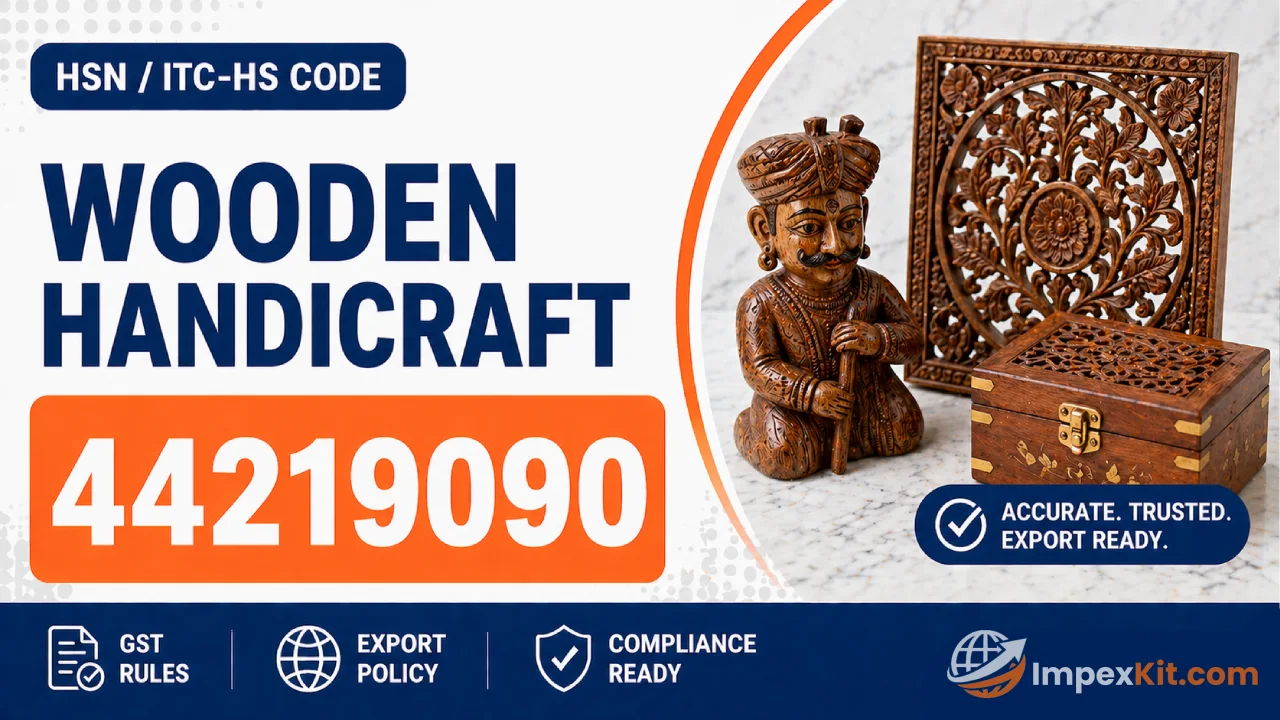
- Primary HSN Code: 44219090
- GST Rate: 12%
- Export Policy: Free (but watch for CITES species like Rosewood)
- Chapter: 44 – Wood and articles of wood
- RoDTEP Rate (2026): 1.1% (Full rate restored as of March 23)
India is one of the world’s largest exporters of wooden handicrafts, with major clusters in Rajasthan (Jodhpur, Jaipur), Uttar Pradesh (Saharanpur, Moradabad), Karnataka (Channapatna), and Jammu & Kashmir (Kashmiri walnut wood carving). Wooden handicrafts – from decorative figurines and carved furniture components to lacquerware boxes and wooden toys – form a significant part of India’s handcraft export basket.
If you manufacture, trade, or export wooden handicrafts, using the correct HSN code on every GST invoice, e-way bill, and shipping bill is mandatory. This guide covers ITC-HS 44219090 – the primary code for wooden handicrafts – along with GST rate, export policy, and RoDTEP applicability.
What Are Wooden Handicrafts?
Wooden handicrafts are decorative, functional, or artistic objects made primarily from wood – crafted by hand or with hand-guided tools, often using traditional techniques passed down through craft clusters. They include carved figurines, decorative boxes, trays, frames, wall panels, toys, home décor items, and religious objects.
India’s wooden handicraft exports include a wide variety of regional craft styles – Sheesham wood furniture carvings from Saharanpur, lacquerware (lac work) items from Rajasthan, Channapatna painted wooden toys from Karnataka, sandalwood carvings from Mysuru, walnut wood carved boxes from Kashmir, and rosewood inlay work from Mysore and Nagpur. All of these – when exported as finished handicraft articles – are primarily classified under HSN 44219090.
HSN Code for Wooden Handicraft – 44219090
The correct HSN code for wooden handicrafts (other articles of wood not elsewhere classified) is 44219090.
| Level | Code | Description |
|---|---|---|
| Chapter | 44 | Wood and articles of wood; wood charcoal |
| Heading | 4421 | Other articles of wood |
| Sub-heading | 442190 | Other articles of wood – not elsewhere specified or included |
| 8-digit | 44219090 | Other articles of wood – handicrafts and decorative items |
Quick breakdown:
- 44 → Chapter: Wood and articles of wood
- 4421 → Heading: Other articles of wood not classified elsewhere
- 442190 → Sub-heading: Other wood articles – residual category
- 44219090 → Full 8-digit ITC-HS code for wooden handicrafts and decorative wood articles
Use 44219090 on all GST invoices, e-way bills, shipping bills, and commercial export invoices for finished wooden handicraft articles.
Which Wooden Handicrafts Use HSN 44219090?
The following wooden handicraft types are correctly classified under 44219090:
- Carved wooden figurines, statues, and religious idols
- Decorative wooden boxes, jewellery boxes, and keepsake boxes (lacquerware, inlay work)
- Wooden photo frames, mirror frames, and wall panels
- Hand-painted wooden trays, bowls, and serving platters (non-tableware grade – see note below)
- Wooden toys – Channapatna toys, pull-along toys, spinning tops
- Wooden key holders, napkin rings, candle holders, and home décor accessories
- Kashmiri walnut wood carved boxes and panels
- Sandalwood and rosewood carved decorative items
What Wooden Products Do NOT Use 44219090?
Not all wooden products fall under 44219090. The Chapter 44 residual code applies only when no more specific heading covers the product. Here are the key exceptions:
| Product | Correct HSN | Why Not 44219090 |
|---|---|---|
| Wooden furniture (tables, chairs, shelves) | 9403 series | Chapter 94 covers furniture specifically |
| Wooden tableware and kitchenware (bowls, spoons used for food) | 44191090 / 44199090 | Heading 4419 covers wooden tableware |
| Wooden picture frames (mass-produced, non-handicraft) | 44140000 | Heading 4414 covers wooden picture frames |
| Wooden beads and bangles | 44219010 | Specific sub-code within 442190 |
| Sandalwood chips / powder (not carved) | 12119013 | Chapter 12 covers plant material for fragrance |
The practical test: If your wooden product is a finished decorative or artistic object that does not fit a more specific Chapter 44 heading and is not furniture or tableware – it belongs in 44219090. If you are uncertain about a specific product, consult your CHA or use the ITC-HS classification system on the DGFT portal. A useful starting point: ITC-HS Code: How to Find the Right 8-Digit Export Code in India (2026)
GST Rate on Wooden Handicraft
GST rate: 12%
| Tax Component | Rate |
|---|---|
| CGST | 6% |
| SGST | 6% |
| IGST (interstate supply) | 12% |
| Export | Zero-rated |
Wooden handicrafts under HSN 44219090 attract 12% GST. This rate applies to both B2B wholesale supply and B2C retail sales of finished wooden handicraft articles.
GST 2.0 Note: The 12% rate for wooden handicrafts under Chapter 44 has remained stable through the post-September 2025 GST 2.0 revision. Verify on cbic-gst.gov.in before invoicing if your product sits at the boundary between handicraft (44219090) and tableware (44191090) or furniture components (Chapter 94), as these attract different GST rates.
For exports, IGST is zero-rated. Filing a Letter of Undertaking (LUT) before each financial year is the standard practice for handicraft exporters to ship without paying IGST upfront. Read: What is LUT in GST – How to File Form RFD-11 Before March 31
Export Policy for Wooden Handicrafts
Export Policy: FREE (with wood-type conditions)
Wooden handicrafts as finished manufactured articles are classified under the Free export category as per Schedule II of India’s ITC-HS Export Policy. This means:
- No export licence required for finished wooden handicraft articles
- No quantity or value restriction on exports
- No prior DGFT approval needed for finished goods
- A valid IEC (Importer Exporter Code) is the only mandatory baseline requirement
Critical wood-type restriction – Red Sanders and Sandalwood: While finished handicraft articles are Free to export, there are strict restrictions on raw and semi-processed wood of specific species. Red Sanders (Red Sandalwood) is restricted for export and requires specific permits. Sandalwood export in raw or unprocessed form is also restricted in several Indian states. If your handicrafts use sandalwood or red sanders, confirm your product is classified as a finished manufactured article – and consult your CHA to verify no additional permits are needed before shipment.
CITES-listed species: Some decorative wood types – including certain rosewood species – may fall under CITES (Convention on International Trade in Endangered Species) controls. Rosewood (Dalbergia species) is listed under CITES Appendix II. Exporters using rosewood in handicrafts must obtain CITES export permits. Confirm with the Wildlife Crime Control Bureau (WCCB) or your CHA before shipping any rosewood-based handicrafts.
⭐ Expert Tip (Avadhut Taru): If you are exporting Sheesham (Dalbergia sissoo) or Rosewood, you will need a Vriksh Certificate (Legal Timber Verification). Also, most buyers in the USA and Europe will require a Fumigation Certificate to ensure the wood is pest-free. Always ask your CHA to arrange fumigation at the CFS (Container Freight Station) before the LEO is issued.
EPCH Registration: Registration with the Export Promotion Council for Handicrafts (EPCH) is strongly recommended for wooden handicraft exporters. EPCH facilitates access to international trade fairs (including the India International Handicrafts Fair), buyer databases, and export promotion schemes. Many serious overseas buyers – especially from Europe and the USA – prefer to source from EPCH-registered exporters.
The “10kg Rule” for Sheesham & Rosewood
If your handicraft is made of Sheesham (Dalbergia sissoo) or Indian Rosewood (Dalbergia latifolia):
- Under 10kg: Items weighing less than 10kg (individual item weight) do not require a CITES permit. You can export them freely with a standard invoice.
- Over 10kg: If an individual piece exceeds 10kg, you must obtain a CITES export permit or a Vriksh Shipment Certificate from EPCH.
- Vriksh Certification: For EU and US markets, having a Vriksh CoC (Chain of Custody) is highly recommended even for small items to prove “Legal Timber” origin under the Lacey Act (USA) or EUDR (EU).
If you are a handicraft artisan or cluster unit setting up exports for the first time, IEC registration is your starting point: What is IEC Code – How to Apply for Import Export Code in India (2026)
RoDTEP and Duty Drawback for Wooden Handicrafts
RoDTEP: Wooden handicrafts under ITC-HS 44219090 are covered under India’s RoDTEP (Remission of Duties and Taxes on Exported Products) scheme. The applicable rate is notified by DGFT and revised periodically. Check the current RoDTEP schedule at dgft.gov.in before filing each shipping bill.
RoDTEP Benefits (2026 Restoration): As per DGFT Notification No. 66/2025-26 (issued March 23, 2026), the government has officially restored the full RoDTEP rates, withdrawing the 50% restriction imposed earlier this year.
- Current Rate: For HSN 44219090, the restored rate is 1.1%.
- Validity: This scheme has been further extended via Notification No. 74/2025-26 and remains valid until September 30, 2026.
- Action Required: Ensure your CHA marks the RoDTEP intent as ‘Y’ on the shipping bill. Since this rate was recently restored, double-check your Export Invoice values to maximize your e-scrip credit.
Duty Drawback: Handicraft exporters using imported inputs – such as imported hardware (metal fittings, hinges, clasps), imported dyes or lacquers, or imported adhesives – may be eligible for All Industry Rate (AIR) drawback on customs duty paid for those inputs. Confirm with your CHA.
ASIDE / State Handicraft Board Schemes: Several state governments – particularly Rajasthan, UP, and Karnataka – offer additional export assistance and reimbursement schemes for handicraft exporters through their State Handicraft Development Corporations and ASIDE (Assistance to States for Infrastructure Development of Exports) funds. These are over and above RoDTEP and worth exploring at the state level.
For all RoDTEP and drawback claims, your export invoice must correctly state ITC-HS code 44219090, IEC, GSTIN, LUT reference, and declared FOB value in foreign currency. Use the Export Invoice Generator to create a fully compliant India-specific export invoice – with all mandatory GST and customs fields built in and no manual formatting errors.
Who Searches for HSN Code 44219090?
This article is relevant for:
- Wooden handicraft manufacturers and artisans in Jodhpur, Saharanpur, Channapatna, Mysuru, and Kashmir filing GST returns and e-way bills
- Handicraft exporters preparing commercial invoices and shipping bills for buyers in the USA, Europe, and the Gulf
- Export agents and buying houses consolidating multi-product handicraft shipments from cluster units
- Online sellers exporting wooden décor and handicrafts via Amazon Global, Etsy, or Faire and needing correct HSN for customs declarations
- CAs and compliance consultants advising handicraft cluster clients on Chapter 44 classification and CITES/Red Sanders compliance
Practical example: A handicraft export unit in Jodhpur sources carved Sheesham wood decorative panels and lacquerware boxes from local artisans, packs them in export-ready cartons, and fulfils a purchase order from a home décor retailer in the Netherlands. They classify the shipment under ITC-HS 44219090, file a shipping bill, reference their LUT on the commercial invoice to export without paying IGST, confirm no CITES restrictions apply to Sheesham wood, and claim RoDTEP credit post-shipment via ICEGATE.
How to Use HSN 44219090 in Your Export Paperwork
Classification is only the first step. To export successfully, you need to apply this code across two categories of documentation:
Category 1: One-Time Setup (The Foundation)
Before you can use HSN 44219090 on a shipping bill, ensure your business is registered.
- IEC & GST: Ensure your IEC Code is updated for 2026.
- LUT Filing: File your Form RFD-11 to export wooden handicrafts at 0% IGST.
- AD Code: Register your bank’s AD code at the specific port (e.g., Mundra or JNPT) you intend to use.
Category 2: Shipment-Specific Docs (The Action)
For every consignment of wooden handicrafts, HSN 44219090 must appear on:
- Commercial Invoice: Must show the full 8-digit code and wood species. Use our Export Invoice Generator to get this right.
- Packing List: Details of wood types, weights, and dimensions.
- Shipping Bill: Your CHA will quote 44219090 to claim your 1.1% RoDTEP benefit.
🔗 Deep Dive: Confused about which documents are one-time vs. per-shipment? Read our Complete 2026 Export Documents Checklist.
Frequently Asked Questions
What is the HSN code for wooden handicraft?
The HSN code for wooden handicraft is 44219090. This 8-digit ITC-HS code covers finished decorative and artistic wooden articles – including carved figurines, lacquerware boxes, wooden toys, candle holders, and decorative trays – that do not fall under a more specific Chapter 44 heading.
What is the GST rate on wooden handicraft?
Wooden handicrafts under HSN 44219090 attract 12% GST – 6% CGST and 6% SGST for intra-state supply, or 12% IGST for interstate transactions. Exports are zero-rated under GST.
Is wooden handicraft export free or restricted in India?
Finished wooden handicraft articles are in the Free export category under Schedule II of India’s Foreign Trade Policy. However, handicrafts made from Red Sanders or rosewood (Dalbergia species) require additional permits – Red Sanders export is restricted and rosewood is subject to CITES Appendix II controls. Confirm species compliance with your CHA before shipment.
Does HSN 44219090 apply to Channapatna toys and Kashmiri walnut wood carvings?
Yes. Channapatna wooden toys, Kashmiri walnut wood carved boxes, Rajasthani lacquerware boxes, and Saharanpur carved wood panels are all classified under 44219090 as finished wooden handicraft articles – provided they are not tableware (heading 4419) or furniture (Chapter 94).
Do I need EPCH registration to export wooden handicrafts from India?
EPCH (Export Promotion Council for Handicrafts) registration is not mandatory for export clearance, but it is strongly recommended. It provides access to trade fairs, buyer databases, and export promotion schemes – and many international buyers prefer EPCH-registered suppliers. A valid IEC is the only mandatory requirement to begin exporting.

Avadhut Taru is the founder of ImpexKit, an engineer by background, and a researcher focused on simplifying import-export documentation and compliance for Indian businesses. Through detailed study of GST regulations, DGFT procedures, customs rules, and exporter compliance requirements, he creates practical tools and educational guides designed to make trade paperwork simpler, faster, and more accessible for Indian exporters.