
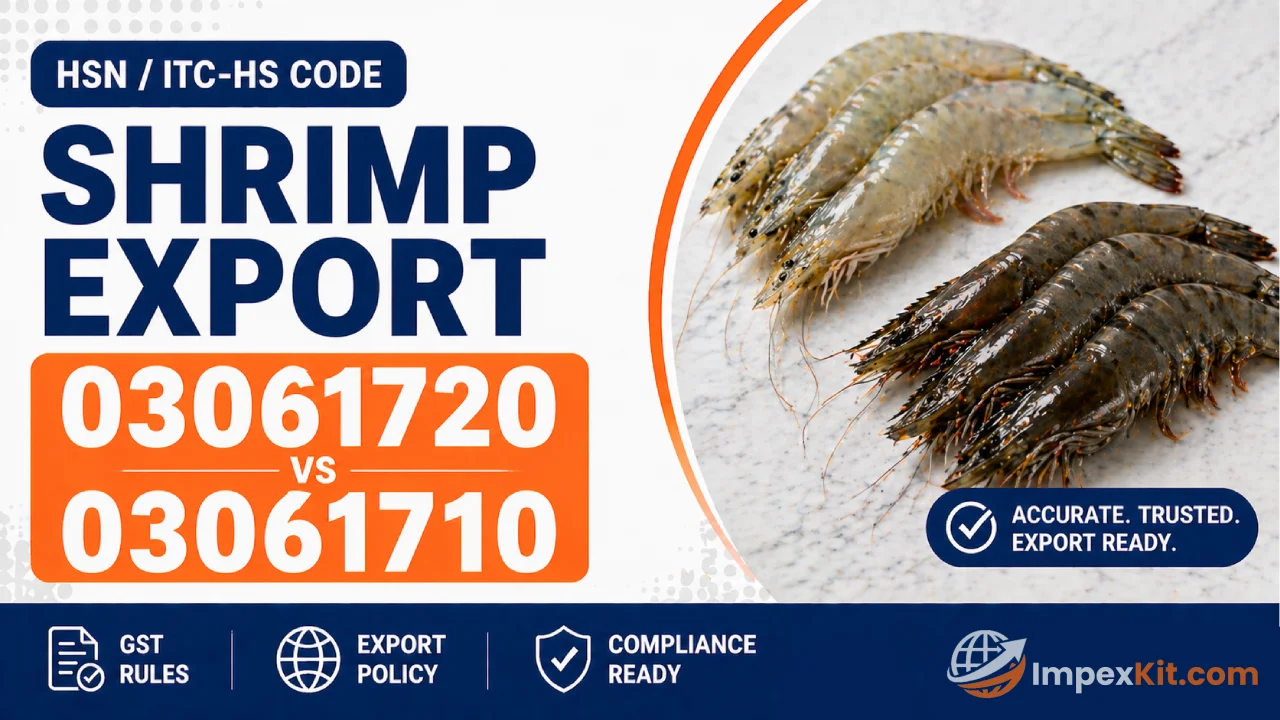
- Primary HSN Code: 03061720 (Vannamei) | 03061710 (Black Tiger)
- GST Rate: 0% (Fresh/Chilled/Frozen – Unbranded) | 5% (Branded/Processed)
- Export Policy: Free (but requires MPEDA Registration)
- Chapter: 42 – Articles of Leather
- RoDTEP Rate (2026): 3.1% (Restored)
India is the world’s largest exporter of shrimp, with annual exports valued at over USD 7 billion to markets across the USA, EU, Japan, China, and the Middle East. Shrimp (prawns) are farmed in coastal states like Andhra Pradesh, Tamil Nadu, West Bengal, and Gujarat, then processed and exported frozen as a premium protein product.
If you farm, process, or export shrimp, understanding the correct HSN code is essential for GST invoicing, shipping bills, MPEDA compliance, and RoDTEP benefit claims. This guide covers the two primary codes – 03061720 for Vannamei shrimp and 03061710 for other farmed shrimp – along with GST rate, export policy, MPEDA requirements, and RoDTEP applicability.
What Are Shrimp (Prawns)?
Shrimp (also called prawns) are crustacean shellfish farmed in aquaculture ponds in coastal India. They are harvested, cleaned, sorted by size, frozen (typically tail-on or head-off), and exported globally as a high-value seafood product.
India’s shrimp farming is dominated by two main species: White-legged shrimp (Penaeus vannamei, or “Vannamei”) and Black Tiger shrimp (Penaeus monodon). Vannamei accounts for over 80% of India’s farmed shrimp production and exports due to higher stocking density, faster growth, and lower disease risk.
HSN Code for Shrimp Export – Two Primary Codes
Shrimp HSN classification depends on the species farmed. India’s two main export codes are:
HSN 03061720 – Vannamei Shrimp (White-Legged)
| Level | Code | Description |
|---|---|---|
| Chapter | 03 | Fish and crustaceans, molluscs and other aquatic invertebrates |
| Heading | 0306 | Crustaceans (shrimps, prawns, lobsters, crabs) |
| Sub-heading | 030617 | Shrimps and prawns – whether or not in shell |
| 8-digit Option 1 | 03061720 | Penaeus vannamei (white-legged shrimp) – frozen |
Use 03061720 for:
- White-legged shrimp (Vannamei) – farmed species
- Frozen shrimp in any form – tail-on, head-off, peeled, deveined
- All sizes and grades of Vannamei shrimp
- The majority of India’s shrimp exports (80%+ volume)
HSN 03061710 – Other Farmed Shrimp (Black Tiger & Others)
| Level | Code | Description |
|---|---|---|
| Chapter | 03 | Fish and crustaceans, molluscs and other aquatic invertebrates |
| Heading | 0306 | Crustaceans (shrimps, prawns, lobsters, crabs) |
| Sub-heading | 030617 | Shrimps and prawns – whether or not in shell |
| 8-digit Option 2 | 03061710 | Other shrimps and prawns (Black Tiger, other species) – frozen |
Use 03061710 for:
- Black Tiger shrimp (Penaeus monodon) – farmed species
- Other farmed shrimp species not Vannamei
- Frozen in any form – tail-on, head-off, peeled, deveined
- Premium/specialty shrimp varieties
Quick Decision Guide
| Shrimp Species | HSN Code | India Production Share | Export Grade |
|---|---|---|---|
| Vannamei (white-legged) | 03061720 | 80%+ | Standard grades (20-count, 30-count, etc.) |
| Black Tiger (monodon) | 03061710 | 15-20% | Premium, larger sizes (10-count, 15-count) |
| Other species | 03061710 | <5% | Specialty / regional variants |
Risk Management: 2026 Export Tip: Ensure every batch is tested in an EIA-approved lab for Nitrofurans and Chloramphenicol. US-FDA and EU customs perform random ‘Point of Entry’ testing; one rejection can lead to a ‘Risk Alert’ on your IEC.
The practical test: Ask your farm supplier or processor which species your shrimp are. “Vannamei” = 03061720. “Black Tiger” or any other = 03061710. Never guess based on size or appearance – species is the deciding factor.
For detailed guidance on aquatic product HSN codes: ITC-HS Code: How to Find the Right 8-Digit Export Code in India (2026)
GST Rate on Shrimp
GST rate: 5% (for both 03061720 and 03061710)
| Transaction Type | Rate |
|---|---|
| Domestic B2B supply (fresh/frozen) | IGST 5% |
| Domestic B2C retail | IGST 5% |
| Interstate trade | IGST 5% |
| Export | Zero-rated (LUT) |
Shrimp under both HSN codes attract 5% GST for domestic supply – the concessional rate applied to most seafood and aquatic products. This applies uniformly to all shrimp sales, regardless of species, size, or processing form (tail-on, head-off, peeled).
GST 2.0 Note: The 5% rate for seafood products (Chapter 03) has remained stable through the post-September 2025 GST 2.0 revision. Verify on cbic-gst.gov.in before invoicing to confirm no changes to aquatic product GST treatment.
For exports, IGST is zero-rated. Filing a Letter of Undertaking (LUT) before each financial year is standard practice for shrimp exporters – this allows shipment without paying IGST upfront and is critical for managing cash flow on large bulk orders. Read: What is LUT in GST – How to File Form RFD-11 Before March 31
Export Policy for Shrimp
Export Policy: FREE
Shrimp exports are classified under the Free export category as per Schedule II of India’s ITC-HS Export Policy. This means:
- No export licence required for farmed shrimp
- No quantity or value restriction on exports
- No prior DGFT approval needed
- A valid IEC (Importer Exporter Code) is the only mandatory baseline requirement to export
MPEDA Registration – Mandatory for Shrimp Exports: While the export policy is Free, registration with MPEDA (Marine Products Export Development Authority) is mandatory for all shrimp exporters in India. This is not optional. MPEDA registration is required to:
- Obtain Export Registration Certificate (ERC) for shrimp exports
- Access international market prices and export data
- Participate in MPEDA-supported trade fairs and buyer connections
- File export customs bills correctly with port authorities
- Comply with seafood safety and traceability regulations
Shrimp exporters without MPEDA registration face customs clearance delays and cannot export. Registering with MPEDA is available through their online portal (mpeda.gov.in) and is a straightforward process for aquaculture farms and processing units.
Check our 2026 Checklist of Export Documents to ensure your paperwork is error-free.
Food Safety & Traceability: International buyers (especially USA and EU importers) require strict compliance with seafood safety standards: HACCP (Hazard Analysis and Critical Control Points), FDA registration (for US exports), and EU food traceability requirements. These are buyer-side requirements, not Indian legal requirements, but failure to meet them will block shipments at destination ports.
Antibiotic Residue Testing: Shrimp exports face routine testing for antibiotic residues (especially from USA and EU) – residue detection can result in complete shipment rejection and long-term buyer blacklisting. Exporters must maintain strict zero-antibiotic protocols in farms and processing facilities.
If you are a shrimp exporter setting up exports for the first time, IEC registration is your starting point: What is IEC Code – How to Apply for Import Export Code in India (2026)
RoDTEP and Duty Drawback for Shrimp Exports
RoDTEP: Shrimp under both ITC-HS 03061720 and 03061710 are covered under India’s RoDTEP (Remission of Duties and Taxes on Exported Products) scheme. The applicable rate is notified by DGFT and revised periodically. Always check the current RoDTEP schedule at dgft.gov.in before filing your shipping bill – RoDTEP rates for seafood have been revised multiple times since scheme launch.
Duty Drawback: Shrimp exporters using imported inputs – such as imported feed, imported processing chemicals, imported packaging materials, or imported machinery parts – may be eligible for All Industry Rate (AIR) drawback on customs duty paid for those inputs. Confirm the applicable drawback schedule with your CHA.
Working Capital Impact: Shrimp exports typically involve large bulk orders (containers) with long production cycles (farm to harvest to processing to cold storage to export). RoDTEP and drawback claims come post-shipment, creating a working capital gap – exporters must factor this into their operational cash flow planning.
Your export invoice must correctly state the applicable ITC-HS code (03061720 or 03061710), IEC, GSTIN, MPEDA registration number, LUT or bond reference, and declared FOB value in foreign currency. Missing MPEDA registration or incorrect fields can delay RoDTEP credit. Use the Export Invoice Generator to create a fully compliant India-specific export invoice – with all mandatory GST, MPEDA, and customs fields built in.
Who Searches for HSN Code 03061720?
This article is relevant for:
- Aquaculture farmers in Andhra Pradesh, Tamil Nadu, West Bengal, and Gujarat filing GST returns on shrimp sales
- Shrimp processing units and exporters preparing commercial invoices and shipping bills for international buyers
- Seafood trading companies consolidating shrimp from multiple farms for bulk export
- MSME processors value-adding shrimp through peeling, deveining, and specialty processing for premium export markets
- CAs and compliance consultants advising aquaculture and seafood sector clients on HSN classification and MPEDA compliance
Practical example: An aquaculture farm in Andhra Pradesh harvests Vannamei shrimp, processes and freezes them tail-on, and receives an export order from a seafood distributor in the USA. They confirm MPEDA registration is current, classify the shipment under ITC-HS 03061720, file a shipping bill, conduct antibiotic residue testing per FDA requirements, reference their LUT on the commercial invoice to export without IGST, and claim RoDTEP credit post-shipment via ICEGATE.
Shrimp Varieties & Regional Production – Local Names
India’s shrimp farming is concentrated in specific coastal regions, each known for particular species and processing styles. While these regional varieties use the same HSN codes (03061720 for Vannamei, 03061710 for others), understanding the regional context helps exporters communicate with suppliers and buyers:
| Region | Primary Species / Local Name | Farming Area / District | Processing Style / Export Grade |
|---|---|---|---|
| Andhra Pradesh | Vannamei (White Shrimp) / “AP Vannamei” | Nellore, Tirupati, Krishna, East/West Godavari | Largest producer; tail-on, head-off, peeled |
| Tamil Nadu | Vannamei & Black Tiger / “TN Shrimp” | Chengalpattu, Kanchipuram, Villupuram | Premium grades; specialty processing |
| West Bengal | Black Tiger (Monodon) / “Sundarbans Tiger” | South 24 Parganas, North 24 Parganas | Organic-marketed; selective harvest |
| Gujarat | Vannamei & others / “Gujarat Shrimp” | Valsad, Navsari, Surat districts | High-density farming; bulk export |
These regional branding and local names (AP Vannamei, Sundarbans Tiger, etc.) do not change the HSN code – but they are marketing and sourcing terms that appear in buyer specifications, farm supply agreements, and export documentation. Exporters should be familiar with them for international buyer communication.
⭐ Expert Tip (Avadhut Taru): The biggest risk in shrimp export is Antioxidant/Antibiotic Residue. If your shipment is rejected by US-FDA or EU customs due to “Nitrofurans,” your company could be blacklisted. Always conduct independent lab testing through an EIA-approved lab before the goods reach the port.
- For USA exports, the DS-2031 Certificate is mandatory to prove the shrimp were harvested without harming sea turtles. Without this, your container will not clear US customs.
Frequently Asked Questions
What is the HSN code for shrimp export?
The HSN code for shrimp export is 03061720 for Vannamei (white-legged) shrimp – which accounts for 80%+ of India’s shrimp exports. For Black Tiger and other farmed shrimp species, use 03061710. Both are used on GST invoices, shipping bills, and export documentation.
What is the GST rate on shrimp?
Shrimp under both HSN 03061720 and 03061710 attract 5% GST for domestic supply and B2B transactions. Exports are zero-rated under GST when filing a Letter of Undertaking (LUT).
Is shrimp export free or restricted in India?
Farmed shrimp exports are in the Free export category under Schedule II of India’s Foreign Trade Policy. However, MPEDA registration is mandatory for all shrimp exporters – this is a regulatory requirement. Without MPEDA registration, customs clearance will be delayed.
What is the difference between HSN 03061720 and 03061710?
03061720 is for Vannamei (white-legged) shrimp – the dominant farmed species accounting for 80%+ of India’s production. 03061710 is for Black Tiger shrimp and other farmed species. The species determines the code; both use the same GST rate and export policy but may have different pricing and buyer preferences.
Is MPEDA registration mandatory for shrimp export?
Yes. MPEDA registration is mandatory for all shrimp exporters. It is required to obtain Export Registration Certificate (ERC) and to clear customs. Exporters without MPEDA registration face customs delays and cannot export. Register on the MPEDA portal (mpeda.gov.in).
What are the food safety requirements for shrimp exports?
Shrimp exporters must meet strict international food safety standards: HACCP compliance, FDA registration (for USA exports), EU food traceability requirements, and zero-antibiotic-residue protocols. These are buyer-side requirements but are critical – antibiotic residue detection results in complete shipment rejection and long-term buyer blacklisting.

Avadhut Taru is the founder of ImpexKit, an engineer by background, and a researcher focused on simplifying import-export documentation and compliance for Indian businesses. Through detailed study of GST regulations, DGFT procedures, customs rules, and exporter compliance requirements, he creates practical tools and educational guides designed to make trade paperwork simpler, faster, and more accessible for Indian exporters.